Wednesday, 20 February 2013

Art Lab Art Stars!

We had a great time piloting our new programme for 9-13 year olds, Art Lab, during the summer holidays. In this new format children come along for an extended art-making workshop over four and a half hours, allowing them the time and creative freedom to really explore and experiment with art ideas and techniques. Children, parents and educators unanimously declared it a great success!

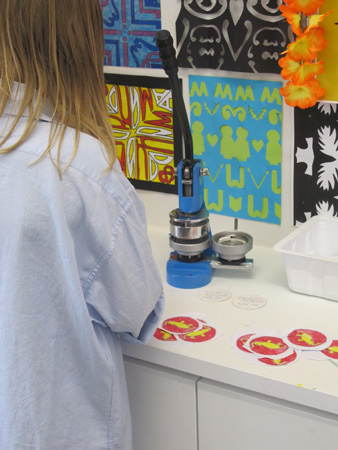
In Art Lab: Merchandise we began by exploring the Who Shot Rock & Roll exhibition and gift shop, which inspired the children in the creation of their own Art Star/Rock Star brand. After thinking about brand development and design ideas, we spent the rest of the day experimenting with etching and collograph printing, silkscreen printing and badge making. The children created an incredible collection of merchandise to promote and publicise their Star identity.


The children worked excitedly all day experimenting with materials and processes to create multiple posters, postcards and badges that had a real authenticity to them. The Gallery staff were so impressed, feeling convinced that these fictional bands would be amazing. Sold out shows all round! The focus on repetition and the multiple meant that the children were all swapping badges with each other at the end of the day, leaving happy and covered in merchandise.


The new format of Art Lab was hugely popular with parents and children alike. It meant that the children could benefit from the extra time for idea-generation and had more opportunity for exploration and experimentation in the studio. We will be continuing with this new format, and will have two Art Labs running during term time as well.


Bookings are now open for our next Art Lab: Project Print which will run on Sunday 10 March. In this one day Art Lab we will take inspiration from artists John Reynolds, Shane Cotton and Richard Killeen as we experiment with everything from silkscreen printing to etching and monoprinting. Find out more and make your booking here.

Friday, 15 February 2013

Auckland Art Gallery celebrates 125 years

The opening of Auckland Art Gallery at 3.30pm on Friday 17 February 1888

It is nearly 125 years since Auckland Art Gallery opened.

No photographs were taken at the opening of Auckland Art Gallery, 3.30pm on Friday 17 February 1888. This was because interior photography, other than in purpose-built portrait studios, was not technically available in Auckland at that time. Yet, from the news coverage, we learn that many people converged at the Gallery’s entrance in Coburg Street (now Kitchener Street) to attend this occasion. The speeches were given inside the exhibition room proudly described as ‘the largest Art Gallery in the Australian Colony…105 feet in length, 32 feet in breadth… with a wall space of 5,890 square feet’. Interestingly, news coverage of the event noted that many women were present. I suppose many of the men who might have been there were at their jobs.


The speakers at the opening were Mayor Albert Devore, Governor Sir William Francis Drummond Jervois, KCMG, CB and Auckland Society of Art President Mr E A McKechnie. The governor said, ‘Ladies and Gentlemen, this Art Gallery is, thanks to Sir George Grey, the first permanent one in New Zealand’. He added, presciently, ‘it is most gratifying to know that there are already many able artists in this country whose work will become the foundation of a New Zealand school of painting’.


The Gallery was still being completed at the time of the Library’s opening on Tuesday 22 March 1887. Sir George Grey, twice governor of New Zealand, had been central to the Grand Opening Ceremony of Auckland’s Public Library. In his address, Grey provided an account of the need for arts and knowledge to inform the public. In early February 1888, Sir George informed the Mayor of Auckland that he was unwell and would be unable to attend the Gallery opening, yet the 28 paintings, which he had gifted, would be on show. The Herald commentator described many of the artworks in detail.

One of the features which emerge from the opening speaker’s comments that day is the notion that Auckland Art Gallery should collect both international and New Zealand art. It was suggested that living artists’ works be included. As well as this, the speakers expressed the wish that the City of Auckland, its businesses and its citizens work together to support both the growth and development of the Gallery.

Mayor Devore commented that although artworks had already been gifted and loaned, he hoped more gifting of art would occur. The governor added he believed Sir George Grey’s philanthropy and his endowment of books and art to the Library and Gallery was expressly ‘for the free use of the people’.

It has been fascinating to review which artworks the public saw on Friday 17 February 1888. They have helped determine the subsequent collection’s growth and focus.


Caspar Netscher’s Girl Arranging Flowers was one of Sir George Grey’s personal favorites; it had belonged to his mother. The 1862 William Ewart painting of his equerry Hami Hone Ropiha (John Hobbs) was the first New Zealand portrait to enter the Gallery’s collection. Governor Grey had commissioned this work. One of the first examples of New Zealand contemporary art shown at the Gallery, which had already entered the collection, was Kennett Watkins’ The Home of the Cormorants, Waitakere Ranges, 1886 – a very recent view of a swamp in west Auckland.

Recalling the opening of the Gallery demonstrates that a vision for the its future existed 125 years ago. The current reality of the Gallery was imagined on that occasion, as was the future nature of the art collection. The opening speakers probably had zero consciousness that the collection would have expanded – at the moment of its 125th anniversary to 15,402 items. All of these can be accessed via the Gallery’s website. So very many of them have been acquired by Auckland’s citizens through our city Council or via gifts, bequests and long-term loans from generous individuals and organisations.


CREDITS:
Caspar Netscher
Girl Arranging Flowers 1683
oil on canvas
Auckland Art Gallery Toi o Tāmaki
gift of Sir George Grey, 1883

William Ewart
Hami Hone Ropiha (John Hobbs) 1862
oil on canvas
Auckland Art Gallery Toi o Tāmaki
gift of Sir George Grey, 1887

Kennett Watkins
The Home of the cormorants, Waitakere Ranges 1886
gouache
Auckland Art Gallery Toi o Tāmaki
gift of students of the artist, 1888

Thursday, 14 February 2013

Grader, 1959

Before we left for the summer holidays a colleague invited me downstairs to view a recently acquired artwork. In the crypt-like Receiving Room we watched registrar Fiona Moorhead unwrap Sybil Andrews’ Grader, 1959.

I’d spent some time studying an image of the linocut on my PC, and the real thing didn’t disappoint. Rolling its way down the tissue-like paper, which is so transparent you can be looking at the reverse of the print without realising it, is the carefully cut image of a piece of mid-century farm machinery full of force and dynamism. Grader exudes energy and charm in part because of Andrews’ management of bold subject matter in a tight composition, and her use of the somewhat homely and accessible linocut technique.

Sybil Andrews, Grader, 1959
linocut, Auckland Art Gallery Toi o Tāmaki, purchased 2012


Representing the rhythms of contemporary life in tightly composed scenes of the city, sport and work, Andrews was a master of her modern medium – the linoleum block print. Made using industrial flooring material, lino prints were considered a lesser art form than wood cut prints. But Claude Flight, leader of the Grosvenor School, rejected the restraints of the past and ignored entrenched hierarchies, declaring that ‘a lino-cut colour print should not look like an oil or water-colour painting, it is a print from a soft linoleum block and should not be taken for a wood-cut, a wood engraving, or an etching, it should take its individual place on a wall and be recognised as a lino-cut’.

In Grader the white blade slices the ground, cutting a curly ribbon of earth as the large front wheels go one way, and the smaller rear wheels another. In the midst of this swirl of curvilinear forms and angles man and machine appear fused, and it’s difficult to establish who’s  in control.  This was very likely an effect Andrews was eager to create. The faceless, lone worker in Grader contrasts Andrews’ earlier scenes of manual labour in which workers come in teams, appearing more abstract – a reflection of her egalitarian interests which she shared with the fellow Grosvenor School linocutters.

Described as ‘British Futurists’, the Grosvenor School linocutters incorporated elements from other styles, like the Italian Futurists celebratory depictions of speed and movement – what Umberto Boccioni feverishly described as ‘our whirling life of steel, of pride, of fever and of speed’. There are also links with what the Vorticists described in Blast as ‘the forms of machinery, factories, new and vaster buildings, bridges and works’. Though most of the Grosvenor School’s scenes of the city and inter-war merriment appear less imbued by pervading unease compared with the Vorticist’s visions of a sinister and dehumanising city.

Andrews produced many of the Grosvenor School’s most enduring images of the 1920s and 30s, including Haulers, 1929 and The Gale, 1930 (both held in Auckland Art Gallery). In Speedway, 1934, we see her suggestion of a more threatening and impersonal machine age, one that might fuse human and machine.

At the height of the linocut movement Andrews used the speed of the city as a metaphor for the modern world. But in 1947 she moved to Canada, and settled in Campbell River, a remote logging and fishing town on Vancouver Island, British Columbia. Although she found herself in an isolated area (more Douglas Fir forests than speedways), Andrews was still able to find local scenes of activity – logging trucks and ploughers at work, ice skaters at play, and these became sources of inspiration for her art. The titles of her works – Logging Team, 1952, Hauling, 1952, Skater, 1953, Ploughing Pasture, 1954 – hint at an on-going interest in movement and manual work.

Auckland Art Gallery holds 12 other works by Sybil Andrews, all of which were gifted to the Gallery by Rex Nan Kivell in 1953, along with more than 200 other British modernist prints. And while the Gallery has some of the best examples of Andrews’ work, until we acquired Grader we had nothing to represent her later career.

- Julia Waite, Assistant Curator / Assistant Project Coordinator

Tuesday, 12 February 2013

The Creative Process: Explore


This year, the Todd Foundation Creative Learning Centre explores the creative process through Tiffany Singh’s work May the Rainbow Always Touch Your Shoulder. Visitors are invited to explore, experiment, create and share through participating in the space. So, let's start with explore. How are people exploring this space and what exactly are they exploring?


Often people enter the room with questions like, ‘What is this room?’ ‘What is that smell? ‘Can we do something in here?’ ‘Who made that artwork?’

From my own observations of engaging with people in here, there are multiple points of entry for people to explore. Coming into the space, visitors immediately begin to explore the source of the scent of the room, the gentle sounds coming from the wind chimes and the feel of the raw blocks of wax. There is a sense of curiosity on their faces as they wonder what this room is about. 


They are physically exploring the room, carefully looking at each aspect of the space, the wall text, the video, the artworks, and activities, and piecing together the connections between all these elements. They are exploring things by themselves or together with family – sometimes even with strangers.

Viewfinders give visitors a chance to explore previous works Tiffany has created, and at the same time relive their childhood when viewfinders were the height of technology!


I am sure that through the year I will witness dozens more ways that people explore this room that I haven’t even realised yet. If you come into the Creative Learning Centre and visit us, talk to us about how you have explored this space and what you have discovered!

- Selina Anderson, Senior Gallery Educator

Thursday, 7 February 2013

John Fields


I was sad to learn that John Fields has passed away In Australia. I have always considered John as one of the most committed camera artists to work in New Zealand. Trained as a scientific photographer, he was employed at The University of Auckland Medical School, where he was responsible for many innovations in forensic photography.

Using both a large format camera and the miniature 35mm, he was equally gifted in uber-detailed set-up imagery as he was with candid photography. An artist of acute intelligence and perception, his architectural documentation of Auckland and the Coromandel regions is without parallel.
I wrote about John for our publication Art Toi and I include that commentary this here:

John Fields made his portrait John Allen, Rangitoto, Auckland on a summer day when both men were swimming off North Shore’s Milford Beach. Fields saw a mesmerising combination of four elements: the dark sea, a low-slung and puffy cumulus cloud, the distant volcanic silhouette of Rangitoto Island and John Allen’s bobbing head. With these he constructed a haunting image. While the photographer was standing in the water off Milford Beach, his camera angle makes it appear as if he was floating above the sea.

Many of Fields’s portraits from the 1970s have this surreal impact, with people observed in disjunctive and surprising oppositions to their physical location. This photograph’s composition draws its tension from the way that the scale of the cloud and volcano juxtapose strangely with Allen’s head. Fields has manipulated the printing of the photograph to emphasise the face, making Allen look glowing and radiant. His long black hair, moustache and self-absorbed expression contribute to the odd, dreamlike impression that the photograph conveys.


Allen looks not only like a quintessential hippie but also like a man from the distant past. By concentrating on his head, Fields creates a figure who seems less like a swimmer than a strange sea creature. This carefully planned image is suffused with an air of mystery. Fields immigrated to New Zealand from America in 1966, after studying photography and filmmaking in Boston. From October 1969 he started using a 5 x 7 inch view camera to document the landscape and architecture of the Auckland region. At the same time, he used his 35mm Leica camera to make photographs of people, always using available light rather than artificial lighting. John Allen, Rangitoto, Auckland is a unique vintage print. No further prints were ever made and the negative was destroyed in an accident.


For my earlier blogs about John
http://aucklandartgallery.blogspot.co.nz/2009/03/john-fields-part-1.html
http://aucklandartgallery.blogspot.co.nz/2009/03/john-fields-part-2.html

CREDITS
John Fields (1938-2013)
Brian Boru Hotel, Thames, 2nd floor with music room June 1973
gelatin silver print
Auckland Art Gallery Toi o Tāmaki, gift of the artist 1976

John Allen, Rangitoto, Auckland 1974
gelatin silver print
Auckland Art Gallery Toi o Tāmaki, purchased 2009

Lands and Deeds Office, High Street, Auckland circa 1970
gelatin silver print
Auckland Art Gallery Toi o Tāmaki, gift of John Stacpoole and John Fields, 1983


Friday, 1 February 2013

Tony Fomison - Archivist and Artist


My colleagues Natasha Conland and Caroline McBride have curated a solo artist exhibition which samples some of the Tony Fomison works of art in this public collection. We are fortunate in having assembled the most extensive holdings of Tony's art, which now includes the remarkable studio papers that Mrs Mary Fomison generously gifted to the Gallery.

As well, Tony Fomison: Archivist and Artist (part of Toi Aotearoa) contains two of the paintings that the Chartwell Collection gifted to the collection. This display shows just some of the brilliant archival resources that the artist's mother ensured would be made accessible to the public. Included is one of the previously unknown gouache portraits found among Tony's studio papers.

For anyone that has not seen a number of Tony Fomison paintings and drawings gathered together, or his archival material, this exhibit is an opportunity to see why Tony is such a significant 20th century New Zealand artist.

I once told some of the All Blacks that this artist would always have an ongoing reputation and public regard simply because of his unique vision. I still reckon that this is a true statement.


Tony Fomison
Beethoven 1981
oil on canvas
Auckland Art Gallery Toi o Tamaki, Chartwell Gift Collection, 2009

Tony Fomison
The Bushman 23 January 1967
gouache
Auckland Art Gallery Toi o Tamaki, from the Tony Fomison Studio Papers,
gift of Mary Fomison, 2009

Friday, 18 January 2013

Drop-in drawing takes off


Drop-in drawing sessions are brand new for us here at the Gallery and even after only two sessions, it’s exciting to see people getting involved and hungry for more! The hour-long drop-ins are focused on a work in the gallery spaces with a prompt to get you started and encourage looking. No booking is required and all materials are provided.

The purpose behind these sessions is to explore, interpret, create and participate, using the artworks as a catalyst to experiment in a fun, informal atmosphere, with enjoyment at the forefront. These are not technical artist-run sessions (absolutely no drawing ‘skill’ is required) – they are not about learning to draw, but about drawing to learn. 


So far, participants have been challenged with a memory game using Tony Cragg’s Glass Stack – they observed a part of this artwork for 30 seconds then turned around to draw it from memory. We have also used Andreas Gursky’s Ocean III as inspiration, not to draw what is in front of us, but to draw what is reflected in the image. The results have been inspired, and varied.

We have had visitors of all ages, from fourteen years and up. Those keen to participate have included overseas visitors, young students and office workers, and the feedback has been overwhelmingly positive. They have enjoyed taking time to look at one image (for up to an hour), see things in a new way, and to try something new. And as one visitor commented, this is a way ‘to not just look but to see’.

We can’t wait to see what people create next week. Keep in touch via our Facebook page and our website for details of future drop-in drawing sessions.

- Selina Anderson, Senior Gallery Educator

Tuesday, 18 December 2012

Selling the Dream: The Art of Early New Zealand Tourism

Leonard Mitchell, New Zealand Centennial exhibition 1939

Selling the Dream: The Art of Early New Zealand Tourism is an ambitiously scaled book. I don't think there is any previous local publication which has comprehensively profiled the conversation between art, illustration and tourism. It shows our art history has avoided the mix between fine art, commercial art and trade development.

Simply put, this book overviews how tourism has been promoted through visual illustration. All the artwork is connected with marketing New Zealand as a venue for national and international tourism.

Stanley Davis, Time 1931

Decades ago many of New Zealand's towns and cities were connected by rail travel. It was our primary means of travel between the regions. The car took over by the mid 1950s and by the late 1960s air-travel became a preferred method of transportation. Rail was king first, though.

The Railways Department had its own Wellington-based art studio. Some of our most best illustrators produced railway banners, travel posters and booklets. Segueing with Railways was the National Publicity Studio developed to work across Government Departments by providing visual material fostering local travel. Railways had first started this notion by promoting tourism in the form of excursions and short-term holidays.

Peter Read, Carefree Holidays c1955
The twelve essays in this book are illuminating. They do not regurgitate earlier research and present a fresh take. Each essay addresses a theme. In thinking about some of the essays I was impressed with how Margaret McClure looks at how tourism developed in tandem with publicity. She shows the effects that aviation had on tourism.

David Pollack evaluates how travel posters related to the international illustration tradition. No one working here had the vision of A.M. Cassandre, Edward McKnight Kauffer or Paul Nash. Their innovative work transformed European travel imagery by inserting the lessons they gained from modern art. In contradistinction, our travel poster artists were visually conservative and much of their work utilises the style of magazine illustration.

Railways Studios, Timaru by the Sea 1936

Richard Wolfe profiles the intermeshing between posters, stamp and booklet design as a way to promote ‘Māoriland’ to a country that was also deemed to be a ‘Playground of the Pacific’. It is fascinating to see how nation's self-branding is reduced to strap lines intended to shape visitor experience.

Mark Derby's essay overviews how influential Māoridom was to the marketing of tourism and how control of Māori representation was not determined by Māori. Mark's contribution to this book could have been given more space for amplification. The inclusion of G.F. Bridgman’s text on Poster Design shows how little researched our design history is. Incidentally, this fact brought to mind the fact that Dr Christopher Thompson could well have contributed to this book. He has more knowledge about design as a form of national marketing than anyone else in this area of art history.


Unknown, Tauranga for Winter Sunshine 1934

Lee Davidson reviews how mountain tourism established New Zealand’s reputation as an adventure playground. Going to alpine zones in trendy clothing has become totally inseparable from the marketing of our sportswear. New Zealand's garment industry sells more sportswear internationally than our boutique fashion houses do.

Gail Ross reveals how illustration became a career path for young artists from as early as 1900 while also mentoring immigrant artists who arrived under the La Trobe scheme. Her essay could have been more extensive as it was ranging over new perspectives on design history. The interface with National Publicity Studio merits much more research, especially now that their archive is more accessible.

Unknown, The Romance of the Rail 1928

Warren Feeney presents a fact often forgotten - ‘The fine arts in New Zealand have always sustained a mutual and beneficial relationship with commercial art.’ Warren’s position is revisionist and all the more impressive because of this approach. I like the way he takes a provocative position to break down the high/low art relationship between painting and illustration. Look at this sentence -‘By the 1950s, the fine arts began to catch up with commercial art.’ I doubt whether I would have read statement that in any New Zealand art book a generation ago.

Barry Hancox indicates that photography and tourist publicity have always intersected here. Late 19th century landscape photography by artists such as Daniel Louis Mundy predated tourist art but showed a way of looking that later influenced it. The conversation between pictorialism and illustrative design is only just beginning to be analysed.

Selling the Dream: The Art of Early New Zealand Tourism deserves close study. It gathers images few people will have encountered outside archives or museums. They have probably never encountered them in a public art gallery. No big exhibition of this material has been attempted. This book is as much about art as it is about New Zealand's promotion of visual identity.

Alan Collins, Night travel is easy c1950

Peter Alsop, Gary Stewart, Dave Bamford
Selling the Dream: The Art of Early New Zealand Tourism
Craig Potton Publishing, Nelson 2012
ISBN 978 1 877517 77 8

Peter Alsop informs me that this book is available from all leading bookstores, and online with a 10% discount and free postage within New Zealand from www.sellingthedream.co.nz

Monday, 10 December 2012

Polynesia: the Mark and Carolyn Blackburn collection of Polynesian art


The Mark and Carolyn Blackburn collection of Polynesian art
Of the collection catalogues I studied this year one that I return to is a testament to what collecting can mean when it is both assiduous and informed. Polynesia: the Mark and Carolyn Blackburn collection of Polynesian art overviews this Hawaii-based collection of over 1,000 items. The Blackburn collection is considered the pre-eminent private collection of Polynesian art.

It is likely that such a collection can never be duplicated again because it focuses on artworks of the highest artistic rarity and quality. Many of the items are also amongst the earliest known examples. When I first saw this catalogue I instantly recognised that only a few public collections hold comparable material. The intelligence of the collector’s acquisition strategy is everywhere evident; it is as if they only decided to acquire the best of the best.

The items presented in Polynesia come from New Zealand, the Austral Islands, the Cook Islands, Fiji, Futuna, Hawaii, Malden Island, Easter Island, Rennell Island, Samoa, Tahiti, Tonga, and the Tuamotus, and other locations. This taxonomic approach is impressive because it very difficult to initiate such a collection on such a comprehensive basis. When the Blackburns began collecting decades ago, such broadness was still possible. It would be unachievable to assemble similarly today.

The Blackburn’s have been close friends of Adrienne Kaeppler for many years and, as the curator of Oceanic Ethnology at the National Museum of Natural History at the Smithsonian Institution in Washington, she was arguably one of the most experienced scholars to write the collection catalogue. Had he been able to contribute, Professor Roger Neich could have beneficially contributed. This is the most impressive catalogue because it is so far-reaching in its information.

Adrienne has commented, 'This is probably the best private collection of Polynesia in the world….They are not just outstanding pieces, but representative objects. It's very unusual for a private collector to look for so many different things.'

I met Mark and Carolyn Blackburn at a Pacific Arts Association conference in Rarotonga a couple of years back. I told them that I believed they had assembled the most important private collection of Polynesian art since that established by William Oldman (1879-1949). The New Zealand government in July 1948 purchased Oldman’s collection. Parts of the collection are now distributed between the Museum of New Zealand, Auckland Museum, Canterbury Museum and Otago Museum.

I certainly hope that the Blackburn collection can remain together because this is what curators call ‘a serious collection’. The Blackburns kept files about all their acquisitions and they extensively read all the literature – be it historical, modern or contemporary. Their collection catalogue is not widely available in New Zealand; four copies are held at Auckland Libraries. I recommend this wonderful book.

To read an interview with Mark Blackburn
http://www.tribalmania.com/INTERVIEW.BLACKBURN.htm

To sample what is held in the Mark and Carolyn Blackburn collection
http://www.bridgemanart.com/search/location/Mark-and-Carolyn-Blackburn-Collection-of-Polynesian-Art/11771

Adrienne Kaeppler
Polynesia: the Mark and Carolyn Blackburn collection of Polynesian art
Honolulu: Distributed by the University of Hawai’i Press, 2010
ISBN 9781883528386


Wednesday, 5 December 2012

Gallery garage sales - then and now

Last week in our weekly staff newsletter I shared a link to this post by artist and designer Kelli Anderson, about her involvement in Martha Rosler's exhibition Meta-Monumental Garage Sale at MoMA. Anderson designed a newspaper available as part of the exhibition, which took the form of a real-life gigantic garage sale in MoMA's atrium.

One of our research librarians replied to let me know that the Gallery once held its own garage-sale-as-exhibition - exactly 37 years ago to the day!


On 5 December 1975 artist David Mealing's week-long exhibition Jumble Sale opened at the Gallery. You can read about the kerfuffle it caused, and Wystan Curnow's opinion on its overall effect, on pages 29-30 of this Gallery Quarterly.

Incidentally, David Mealing is now curator and manager of the NZ Cricket Museum in Wellington.