Last week in our weekly staff newsletter I shared a link to this post by artist and designer Kelli Anderson, about her involvement in Martha Rosler's exhibition Meta-Monumental Garage Sale at MoMA. Anderson designed a newspaper available as part of the exhibition, which took the form of a real-life gigantic garage sale in MoMA's atrium.
One of our research librarians replied to let me know that the Gallery once held its own garage-sale-as-exhibition - exactly 37 years ago to the day!
On 5 December 1975 artist David Mealing's week-long exhibition Jumble Sale opened at the Gallery. You can read about the kerfuffle it caused, and Wystan Curnow's opinion on its overall effect, on pages 29-30 of this Gallery Quarterly.
Incidentally, David Mealing is now curator and manager of the NZ Cricket Museum in Wellington.
Showing posts with label Amy Cooper. Show all posts
Wednesday, 5 December 2012
Gallery garage sales - then and now
Labels:
Amy Cooper,
Exhibitions,
Gallery history,
Research Library
Tuesday, 4 December 2012
Staff spotlight: Scott Everson
As exhibitions designer and
coordinator, Scott is part of the Collections team responsible for handling the
artworks and physically delivering the exhibitions at the Gallery.
He works closely with
curators, conservators, technicians and artists to develop the display and look
of the gallery spaces, as well as overseeing their installation… which can
involve anything from deciding where to hang a painting, to figuring out how to
secure 70 live goldfish into the passenger seats of a chartered plane!
What’s the best part
of your job?
The variety that comes
from working with art and artists is always really exciting and inspirational. I
think it's a real privilege to be part of what we do at the Gallery. Dealing
with such interesting and culturally significant items while collaborating with
talented people never really gets old.
What are the
challenges?
Beside the regular
practical and technical ones, working with content that many people, not just
the artist, are so passionate about is a pretty delicate exercise at times.
Concepts and practicality or ideal aesthetics don't always align, so
establishing that level of mutual trust required to come up with a compromise
that responds to everyone's needs can take a lot of work, particularly when
you're working off plans and drawings rather than with the actual piece in a
finished gallery space.
How do you want people
to react when they walk into a space you’ve designed?
It really depends on the
type of show and artwork we're displaying. Often the best exhibition design is
one that only a few people might notice. Generally if we've got it right I'd
hope visitors’ reactions and feelings will be driven by or at least align with
the art on display and what the artists or curators originally wanted to
communicate or provoke. Hopefully the exhibition design just helps this along a
bit, enhancing the experience.
Out of all the shows
you’ve worked on, which one(s) stand out as being your
favourite?
I definitely could never
pick one, that’s kind of like having to pick an all time favourite song and I'd
probably come up with a different answer each day of the week. There are some
like Yinka Shonibare MBE or For Keeps at the old NEW Gallery that
still stand out because I'm such a fan of the elegant and slickly produced art
that was in them.
With shows like the
Julian & Josie Robertson Promised Gift and Degas to Dalí it's
really humbling and memorable to be involved with such historically impressive
and valuable pieces, while others like the Walters Prize or some of our large
scale commissions are cool just because of the professional relationships and
processes it took to deliver them.
We've just opened Who Shot Rock
& Roll so of course that sticks out. I've always spent a lot of time
going to live gigs so there's a lot of stuff in there that interests me. Gail
Buckland (curator) and Roger Taberner (coordinating curator) were great to work
with, giving me a lot of freedom to have some fun with the design and
layout.
What are your
interests outside of work?
I've got three old
American cars that keep me entertained and poor when I'm not watching friends’
bands at some local dive bar. Actually, the only roadworthy car we've got at the
moment is a ‘77 Chevy Camaro with a bit of drag racing history; it makes grocery
shopping and running errands fun. Although they're gathering dust right now,
I've also got a ‘51 Chevrolet I've been restoring and customising for way too
long and a ‘51 Mercury Coupe which is more pile of rusty metal than vehicle at
the moment.
Messing around with them
in the garage is a good distraction if I'm getting too tied up in an exhibition,
but for me there's also a real similarity with the kind of form versus function
problem-solving and satisfaction I get from working on shows at the
Gallery.
Friday, 30 November 2012
The friendly face of the Gallery
Last week I spent two days in Wellington at the National Digital Forum having my mind blown. Some of the most brilliant minds in the international galleries, libraries, archives and museums sector were there, talking about the wonderful ways we can reach our visitors and improve access to our collections online.
Courtney Johnston, director of The Dowse and the Petone Settlers Museum (and who blogs over at Best of 3), gave an especially inspirational talk that reminded me of the importance of making emotional connections with our visitors.
At one point Courtney mentioned a friend who’d felt lost and confused while visiting a gallery. She compared these feelings to the online experience of getting a 404 (page not found) or 403 (access forbidden) message while browsing. The best way to prevent or counter them? Make your front of house staff the ‘fail whales’ of your organisation – the friendly reassuring face who explains what’s going on and gets you back on track.
As I sat in Te Papa’s lecture theatre listening to Courtney’s talk, I felt so proud of our guide team back home. We have 50 friendly gallery guides on staff, from many different backgrounds, but all with an astounding knowledge of the visual arts. If you do find yourself wandering in circles, they can help with that, but more importantly, they love to talk about the stuff on the walls. If you’re wondering what on earth you’re looking at or why it’s important, have a chat with one of them.
The guide team don’t roam the galleries to keep you in line. They exist to enrich your experience.
Guides are easy to spot – they all have the same t-shirt or jacket (right now they’re sporting ‘CREW’ t-shirts in conjunction with our exhibition Who Shot Rock & Roll), and most have a handy bag with an ‘i’ on it that’s packed with useful things like maps and brochures.
If you’re adventuring in our galleries and realise you need some direction – be it physical, intellectual or emotional – look around you. There’ll be a guide nearby who can give you what you need.
I should also mention the stellar job done by the volunteer guides who give our free daily tours – another crucial part of the visitor experience we provide.
We’re constantly getting feedback from our visitors about the amazing work our guide team does:
• ‘Thanks for being so helpful and informative about the gallery.’
• Visitor commented on how much she enjoyed having guides to discuss art with, as she was travelling on her own, and said it was a great initiative, something she hadn’t come across elsewhere.
• ‘The guides bring this space alive! It’s great to hear the stories.’
• ‘You were wonderful – you really opened it up for us.’
• ‘Thank you! Our guides and guards don’t talk much. What an absolute pleasure to talk with you – it has made our visit!’ (Couple from New York)
• A visitor said she had been told at the entrance to ask guides about the art in each of the rooms, and she had found it very rewarding: ‘I’m very pleased I did!’
• ‘It’s great how the guides have encouraged us, and facilitated us around the gallery.’
• ‘Thank you for all your knowledgeable information. It makes it so much more enjoyable when people explain things.’
• ‘The guides are an asset to the gallery, and all so lovely to talk to.’
I’m so proud to work in an organisation with such a friendly face. Hurrah for the guides!
Courtney Johnston, director of The Dowse and the Petone Settlers Museum (and who blogs over at Best of 3), gave an especially inspirational talk that reminded me of the importance of making emotional connections with our visitors.
At one point Courtney mentioned a friend who’d felt lost and confused while visiting a gallery. She compared these feelings to the online experience of getting a 404 (page not found) or 403 (access forbidden) message while browsing. The best way to prevent or counter them? Make your front of house staff the ‘fail whales’ of your organisation – the friendly reassuring face who explains what’s going on and gets you back on track.
As I sat in Te Papa’s lecture theatre listening to Courtney’s talk, I felt so proud of our guide team back home. We have 50 friendly gallery guides on staff, from many different backgrounds, but all with an astounding knowledge of the visual arts. If you do find yourself wandering in circles, they can help with that, but more importantly, they love to talk about the stuff on the walls. If you’re wondering what on earth you’re looking at or why it’s important, have a chat with one of them.
The guide team don’t roam the galleries to keep you in line. They exist to enrich your experience.
Guides are easy to spot – they all have the same t-shirt or jacket (right now they’re sporting ‘CREW’ t-shirts in conjunction with our exhibition Who Shot Rock & Roll), and most have a handy bag with an ‘i’ on it that’s packed with useful things like maps and brochures.
If you’re adventuring in our galleries and realise you need some direction – be it physical, intellectual or emotional – look around you. There’ll be a guide nearby who can give you what you need.
I should also mention the stellar job done by the volunteer guides who give our free daily tours – another crucial part of the visitor experience we provide.
We’re constantly getting feedback from our visitors about the amazing work our guide team does:
• ‘Thanks for being so helpful and informative about the gallery.’
• Visitor commented on how much she enjoyed having guides to discuss art with, as she was travelling on her own, and said it was a great initiative, something she hadn’t come across elsewhere.
• ‘The guides bring this space alive! It’s great to hear the stories.’
• ‘You were wonderful – you really opened it up for us.’
• ‘Thank you! Our guides and guards don’t talk much. What an absolute pleasure to talk with you – it has made our visit!’ (Couple from New York)
• A visitor said she had been told at the entrance to ask guides about the art in each of the rooms, and she had found it very rewarding: ‘I’m very pleased I did!’
• ‘It’s great how the guides have encouraged us, and facilitated us around the gallery.’
• ‘Thank you for all your knowledgeable information. It makes it so much more enjoyable when people explain things.’
• ‘The guides are an asset to the gallery, and all so lovely to talk to.’
I’m so proud to work in an organisation with such a friendly face. Hurrah for the guides!
Labels:
Amy Cooper,
Gallery Guides,
visitors
Tuesday, 23 October 2012
Staff spotlight: Mathew Norman
Mathew Norman is like a kid in a candy store. Only instead of sweet treats,
the objects of his desire can be found in Auckland Art Gallery’s collection of
historic works on paper.
Mathew joined the Gallery in July as assistant curator. It’s not his first time on staff – in 2008 he was awarded a Marylyn Mayo internship and spent nine weeks researching a staggering 1,500 artworks.
Prior to joining the Gallery, Mathew worked in the print collection at the British Museum in London, where he received two prestigious scholarships. He’s also worked at Te Papa, the Ministry for Culture and Heritage and at the National Gallery of Ireland… and in a dairy factory.
Mathew is responsible for the international print collection, supporting Mary Kisler in her role as Senior Curator, Mackelvie Collection, International Art. He also facilitates visits to the Gallery’s print room and supervises students and visitors as they examine the artworks.
One of the biggest drawcards of the role for Mathew was access to the Gallery’s collection. “This is one of the three finest collections in New Zealand from an historical perspective – and we have a superb print collection with real depth, which makes it possible to produce exhibitions and scholarship of merit.”
The Gallery’s collection of more than 15,000 artworks contains a large number of objects by unknown artists. Mathew is undertaking research to help ‘fill in the gaps’, and has already had some success in identifying artists. At the end of October he’ll be presenting a talk about a seventeenth-century oil painting titled Battle Scene, which he believes he’s been able to attribute to a specific artist. “I’m awaiting the opinion of an expert in the Netherlands, but the evidence points to the artist I have identified,” he says.
On top of this, Mathew’s busy planning an exhibition called Travels with Mr Hollar which will open in early 2013. It will be the Gallery’s first large-scale exhibition of work by 17th century Bohemian artist Wenceslaus Hollar.
So how do curators put together an exhibition? “I get the impression people think we just dream up a list of objects and throw them up on the wall or onto plinths – of course it’s not that easy. There’s a huge amount of teasing out of the relationships between the works that has to be done. There has to be a rationale and it has to be obvious to visitors.”
Mathew says the best part of his job is the hands-on access to artworks. “I’m not a theoretician. I’m about the objects themselves,” he says. “I consider myself very lucky to be able to work with objects of real international significance.”
When he’s not poring over prints, Mathew enjoys cheese and baroque music, and is currently dreaming of setting up his own vegetable garden.
Mathew joined the Gallery in July as assistant curator. It’s not his first time on staff – in 2008 he was awarded a Marylyn Mayo internship and spent nine weeks researching a staggering 1,500 artworks.
Prior to joining the Gallery, Mathew worked in the print collection at the British Museum in London, where he received two prestigious scholarships. He’s also worked at Te Papa, the Ministry for Culture and Heritage and at the National Gallery of Ireland… and in a dairy factory.
Mathew is responsible for the international print collection, supporting Mary Kisler in her role as Senior Curator, Mackelvie Collection, International Art. He also facilitates visits to the Gallery’s print room and supervises students and visitors as they examine the artworks.
One of the biggest drawcards of the role for Mathew was access to the Gallery’s collection. “This is one of the three finest collections in New Zealand from an historical perspective – and we have a superb print collection with real depth, which makes it possible to produce exhibitions and scholarship of merit.”
The Gallery’s collection of more than 15,000 artworks contains a large number of objects by unknown artists. Mathew is undertaking research to help ‘fill in the gaps’, and has already had some success in identifying artists. At the end of October he’ll be presenting a talk about a seventeenth-century oil painting titled Battle Scene, which he believes he’s been able to attribute to a specific artist. “I’m awaiting the opinion of an expert in the Netherlands, but the evidence points to the artist I have identified,” he says.
On top of this, Mathew’s busy planning an exhibition called Travels with Mr Hollar which will open in early 2013. It will be the Gallery’s first large-scale exhibition of work by 17th century Bohemian artist Wenceslaus Hollar.
So how do curators put together an exhibition? “I get the impression people think we just dream up a list of objects and throw them up on the wall or onto plinths – of course it’s not that easy. There’s a huge amount of teasing out of the relationships between the works that has to be done. There has to be a rationale and it has to be obvious to visitors.”
Mathew says the best part of his job is the hands-on access to artworks. “I’m not a theoretician. I’m about the objects themselves,” he says. “I consider myself very lucky to be able to work with objects of real international significance.”
When he’s not poring over prints, Mathew enjoys cheese and baroque music, and is currently dreaming of setting up his own vegetable garden.
Labels:
Amy Cooper,
Mathew Norman,
New staff,
staff spotlight
Tuesday, 4 September 2012
One year on
It’s been an entire year since we opened the doors of the newly restored and expanded Auckland Art Gallery!
I've been enjoying reading back through the archives of this blog to see the years of hard work that led up to this moment, right from the moment we closed our doors
and emptied the galleries.
A webcam kept the public (and staff!) up-to-date
as demolition began.
In 2009 we let people see into the future with an animated ‘fly-through’ of the Gallery.
In early 2010 we looked back at the progress to date with a nifty timelapse video.
Finally work drew to a close and on 6 June 2011 we were able to announce an opening date!
But before that could happen, we had to start moving everything back in… Being allowed to explore the newly restored building was an exciting and humbling experience. The moment when the first painting was hung in the developed galleries was momentous. Finally we took over the new office spaces and the Gallery and its Māori dimension commissions were blessed in a dawn ceremony.
And finally on 3 September 2011 we opened, with fanfare and fun and performances and street art and crowds. Hearing the feedback from visitors in those opening weeks never gets old:
In the last year we’ve:
![]() |
| Crowds enter the Gallery on opening day |
But before that could happen, we had to start moving everything back in… Being allowed to explore the newly restored building was an exciting and humbling experience. The moment when the first painting was hung in the developed galleries was momentous. Finally we took over the new office spaces and the Gallery and its Māori dimension commissions were blessed in a dawn ceremony.
And finally on 3 September 2011 we opened, with fanfare and fun and performances and street art and crowds. Hearing the feedback from visitors in those opening weeks never gets old:
In the last year we’ve:
- Held 32 exhibitions
- Seen the gallery spaces taken over by dancers, string quartets, blues bands, and hip-hop crews
- Released multiple publications
- Won 12 awards for our beautiful building
- And welcomed more than 677,000 visitors through our doors!
Friday, 29 June 2012
Tales from the Cloakroom
The majority of our blog entries come from back-of-house staff. But if you're after 'better work stories' the best place to go is our talented team of Gallery Guides. With visitors from all walks of life coming through the doors every day, they've all got stories to tell of an unusual encounter or a truly bizarre question.
Just as a taster, here's a list of the strangest things visitors have checked into the cloakroom:
- An empty bowl of noodles
- Half a beer
- A large bowl of hummus
- A herb garden in a bucket
- Shoes
- A ceremonial axe
- A giant helium balloon
- Many bunches of flowers
- A whole raw fish
Labels:
Amy Cooper,
behind the scenes,
Gallery Guides
Tuesday, 1 May 2012
Leo Bensemann (1912-1986)
Ron Brownson invited Professor Peter Simpson to mark the 100th anniversary of Leo Bensemann's birth.
Leo Bensemann (who died in 1986) was born exactly 100 years ago on May 1, 1912, sharing his birth year with poet and printer, Denis Glover (1912-80), with whom he forged a creative relationship as co-partners of the Caxton Press – the Christchurch firm which published most of the important New Zealand writers of the middle decades of last century, including Ursula Bethell, Allen Curnow, ARD Fairburn, RAK Mason, Frank Sargeson, Charles Brasch, Robin Hyde, James K. Baxter, Janet Frame, Maurice Duggan, Ruth Dallas, E. Mervyn Taylor, Kendrick Smithyman and many others.
Glover and Bensemann joined forces in 1938, shortly after Caxton published Bensemann’s remarkable book Fantastica: Thirteen Drawings (1937), a weird and wonderful collection of ink drawings illustrating texts that ranged from Marlowe’s Dr Faustus and Grimm’s stories to the Arabian Nights and Chinese and Japanese folk tales – a collection that is unique in New Zealand art. For, as well as being a notable typographer, printer and publisher, the versatile Bensemann was also a visual artist of rare distinction.
Bensemann was born to a German father and an Irish/English mother (all New Zealand born) in Takaka, a remote valley in north-west Nelson that opens into Golden Bay, a sheltered and beautiful marine area at the top of the South Island. Leo’s father was the local blacksmith, and he was close to his German grandparents who farmed in the area and from whom he learned to read and speak German, an interest he maintained throughout his life. In 1925 he went to Nelson College, forming a lifelong friendship with fellow-student, Lawrence Baigent. When Lawrence moved to Christchurch with his widowed mother in 1931 to attend university Leo was invited to live with them, benefitting enormously from access to the books, art and music of the cultivated Baigent household which contrasted with his own culturally meagre working-class home.
In 1938, after Mrs Baigent died, Leo and Lawrence shared lodgings with Rita Angus at 97 Cambridge Terrace in Christchurch, a dwelling which became the epicentre of advanced art, music and literature in the city, initiating a period of mutual stimulus between the two artists that resulted in many strong portraits and self-portraits. Rita and Leo drew and painted each other on several occasions, portraits which shared the characteristics of bold colour, sharp clean lines, well-integrated landscape backgrounds, and a love of visual theatre and role-play.
Rita introduced Leo to The Group, a small independent gathering of artists which became the most important outlet for progressive art in the middle decades of last century, and which included Toss Woollaston, Colin McCahon, Doris Lusk, Louise Henderson, Olivia Spencer Bower, William Sutton and others. From 1940 Bensemann designed and printed at Caxton all The Group’s annual catalogues, thus forging important links between the worlds of the visual arts, literature and publishing.
Unlike most Group artists, Bensemann at first largely avoided landscape in favour of portraits and graphic work. A change came in the 1960s, however, when he belatedly turned to landscape painting which dominated the last decades of his career, especially after 1965 when he rediscovered as subject matter the Takaka/Golden Bay region of his childhood.
Auckland Art Gallery has recently acquired two fine examples of Bensemann’s painting – an early portrait and a late landscape. Huntsman (1938), a small, vivid and challengingly transgressive work, shows Bensemann adapting the ‘fantastical’ manner of his graphic work to oil painting. The bizarre-looking huntsman of the title seems to have stepped directly out of German folk-lore into a setting coloured by 1930s surrealism. He also excelled at more conventional portraiture of friends and family members, including among his subjects Glover, Baigent, Angus, Lusk, Douglas Lilburn, Caroline Oliver, Albion Wright, Trevor Moffitt and his (Leo’s) wife Mary, whom he married in 1943.
Burning Hills, Takaka (1974), was painted for an exhibition held during the Commonwealth Games in Christchurch in 1974. He wrote in a letter: ‘I am working on a very large (for me) landscape of the Takaka Valley with a hill on fire – all very dramatic and symbolic’; a frieze of dead and living trees in the foreground adds to the rich connotations of the burning hillsides, a sight that would have been very familiar to Bensemann from his childhood in Takaka. In this painting he breathes life into a motif (bush fires and dead trees) that had flourished in earlier decades but which had largely disappeared by the 1970s.
It was wholly characteristic of Bensemann to be always somewhat out of step with his times, a trait that reflects his conscious adoption of an ‘outsider’ perspective, a perspective that has tended to delay recognition of his singular talent. Increasingly, though, Leo Bensemann has come to be recognised as joining as an equal his distinguished friends and contemporaries – Angus, Brasch, Curnow, Glover, Lilburn, Lusk, McCahon, Sutton – as one of a foundational generation of Modernists within New Zealand’s cultural history.
Peter Simpson is the author of Fantastica: The World of Leo Bensemann (Auckland University Press, 2011)
Leo Bensemann (who died in 1986) was born exactly 100 years ago on May 1, 1912, sharing his birth year with poet and printer, Denis Glover (1912-80), with whom he forged a creative relationship as co-partners of the Caxton Press – the Christchurch firm which published most of the important New Zealand writers of the middle decades of last century, including Ursula Bethell, Allen Curnow, ARD Fairburn, RAK Mason, Frank Sargeson, Charles Brasch, Robin Hyde, James K. Baxter, Janet Frame, Maurice Duggan, Ruth Dallas, E. Mervyn Taylor, Kendrick Smithyman and many others.
Glover and Bensemann joined forces in 1938, shortly after Caxton published Bensemann’s remarkable book Fantastica: Thirteen Drawings (1937), a weird and wonderful collection of ink drawings illustrating texts that ranged from Marlowe’s Dr Faustus and Grimm’s stories to the Arabian Nights and Chinese and Japanese folk tales – a collection that is unique in New Zealand art. For, as well as being a notable typographer, printer and publisher, the versatile Bensemann was also a visual artist of rare distinction.
Bensemann was born to a German father and an Irish/English mother (all New Zealand born) in Takaka, a remote valley in north-west Nelson that opens into Golden Bay, a sheltered and beautiful marine area at the top of the South Island. Leo’s father was the local blacksmith, and he was close to his German grandparents who farmed in the area and from whom he learned to read and speak German, an interest he maintained throughout his life. In 1925 he went to Nelson College, forming a lifelong friendship with fellow-student, Lawrence Baigent. When Lawrence moved to Christchurch with his widowed mother in 1931 to attend university Leo was invited to live with them, benefitting enormously from access to the books, art and music of the cultivated Baigent household which contrasted with his own culturally meagre working-class home.
In 1938, after Mrs Baigent died, Leo and Lawrence shared lodgings with Rita Angus at 97 Cambridge Terrace in Christchurch, a dwelling which became the epicentre of advanced art, music and literature in the city, initiating a period of mutual stimulus between the two artists that resulted in many strong portraits and self-portraits. Rita and Leo drew and painted each other on several occasions, portraits which shared the characteristics of bold colour, sharp clean lines, well-integrated landscape backgrounds, and a love of visual theatre and role-play.
Rita introduced Leo to The Group, a small independent gathering of artists which became the most important outlet for progressive art in the middle decades of last century, and which included Toss Woollaston, Colin McCahon, Doris Lusk, Louise Henderson, Olivia Spencer Bower, William Sutton and others. From 1940 Bensemann designed and printed at Caxton all The Group’s annual catalogues, thus forging important links between the worlds of the visual arts, literature and publishing.
Unlike most Group artists, Bensemann at first largely avoided landscape in favour of portraits and graphic work. A change came in the 1960s, however, when he belatedly turned to landscape painting which dominated the last decades of his career, especially after 1965 when he rediscovered as subject matter the Takaka/Golden Bay region of his childhood.
Leo Bensemann, Huntsman, 1938
oil on board, Auckland Art Gallery Toi o Tāmaki, purchased 2012
Auckland Art Gallery has recently acquired two fine examples of Bensemann’s painting – an early portrait and a late landscape. Huntsman (1938), a small, vivid and challengingly transgressive work, shows Bensemann adapting the ‘fantastical’ manner of his graphic work to oil painting. The bizarre-looking huntsman of the title seems to have stepped directly out of German folk-lore into a setting coloured by 1930s surrealism. He also excelled at more conventional portraiture of friends and family members, including among his subjects Glover, Baigent, Angus, Lusk, Douglas Lilburn, Caroline Oliver, Albion Wright, Trevor Moffitt and his (Leo’s) wife Mary, whom he married in 1943.
Leo Bensemann, Burning Hills, Takaka, 1973
oil on Swedish hardboard, Auckland Art Gallery Toi o Tāmaki, purchased with the assistance of Peter Jarvis, in memory of Adrienne Jarvis, 2011
Burning Hills, Takaka (1974), was painted for an exhibition held during the Commonwealth Games in Christchurch in 1974. He wrote in a letter: ‘I am working on a very large (for me) landscape of the Takaka Valley with a hill on fire – all very dramatic and symbolic’; a frieze of dead and living trees in the foreground adds to the rich connotations of the burning hillsides, a sight that would have been very familiar to Bensemann from his childhood in Takaka. In this painting he breathes life into a motif (bush fires and dead trees) that had flourished in earlier decades but which had largely disappeared by the 1970s.
It was wholly characteristic of Bensemann to be always somewhat out of step with his times, a trait that reflects his conscious adoption of an ‘outsider’ perspective, a perspective that has tended to delay recognition of his singular talent. Increasingly, though, Leo Bensemann has come to be recognised as joining as an equal his distinguished friends and contemporaries – Angus, Brasch, Curnow, Glover, Lilburn, Lusk, McCahon, Sutton – as one of a foundational generation of Modernists within New Zealand’s cultural history.
Peter Simpson is the author of Fantastica: The World of Leo Bensemann (Auckland University Press, 2011)
Labels:
Amy Cooper,
in memoriam,
Peter Simpson,
Ron Brownson
Thursday, 26 April 2012
Have you seen Degas to Dalí yet?
Degas to Dalí has been getting a great response from our visitors - we're loving hearing the comments made to our Gallery guides, volunteer guides and other front of house staff. In addition to this feedback, everyone who visits the show gets handed an entry form to win a trip to Melbourne, on which we
ask them:
‘What would you tell someone, who hasn’t yet been to
the exhibition, about Degas to Dalí?’
It seems the artworks on display have our visitors’
creative juices flowing, as some of the answers we’ve seen are downright
poetic.
So here, in
our visitors’ own words, are 10 great reasons to come and see Degas to Dalí:
10. It’s
here, now, right in front of your eyes
- ‘This is a once in a lifetime chance to see the works of the best modern artists in the world.’
- ‘Go and see it! You rarely see a touring show of this calibre in Auckland.’
- ‘A wonderful collection of art rarely seen down under!’
- ‘It's an amazing experience to see the masters' work in real life and to see the scale and textural detail of the work.’
- ‘The best exhibition to hit town in ages: Broad in scope, informative, intelligently presented. Some truly iconic works!’
- ‘It is a must-see, and how lucky we are to have an exhibition of this calibre here at a reasonable cost.’
- ‘Please go - you will see the best of the best and be home in time for tea.’
- ‘Go! I am so privileged to have seen, first hand, masters' works here in New Zealand. A rare and precious opportunity.’
- ‘Unprecedented close access to major artists of the period in a coherent precise and relevant order. Must-see show for all.’
9. It’s
alive!
- ‘Really special exhibition, so great to see the works leap out of their frames with aliveness.’
- ‘You have to see the originals. Even the best copy lacks the "aliveness" of the originals. Amazing!’
- ‘The atmosphere, from the ticket seller to other members of the public, was warm and friendly. Could go again.’
- ‘Vivid liveliness of original paintings. One off chance to see work of famous artists.’
- ‘Just go! The pictures are alive and waiting to enrapture.’
8. There’s
art in it. Lots of art.
- ‘An impressive journey through outstanding areas of art.’
- ‘Lots of various styles of art so something for everyone.’
- ‘An amazing walk through time!’
- ‘A sizzling spin through modern art.’
- ‘Grand variety of artists of the period.’
7. You’ll
learn something new
- ‘Make a point of seeing this watershed exhibition. It shows you how art changed so much in those crucial years.’
- ‘Go, see, listen and hear. The artists speak to us through their work, of history, of change, challenge the conflicts of emotion of society, theirs and ours. You'll come away excited by new ideas and with a fresh perspective about our life and our place in this place, New Zealand.’
- ‘It vividly illustrates the ideas behind the way art has evolved.’
- ‘Degas to Dalí is not just about artists beginning with D but gives a great presentation and insight into the birth and evolution of modern art.’
- ‘Ever wondered what happened to painting after the invention of photography? Go to Degas to Dalí and see.’
- ‘Do Go! It is an exemplary exhibition-stimulating, thought-provoking, captivating.’
- ‘It’s not only interesting but also very “edumacational”.’
6. It’ll
stimulate your senses:
- ‘A feast of colour and light.’
- ‘Go, see, listen and hear the artists speak through their work.’
- ‘You will walk into the gallery and approach the first frame. Your eyes will grow wide and you will quietly mouth "wow!"’
- ‘I was blown away by the light, the colour, and the knowledge that I was viewing original paintings!’
- ‘An adventure in colour and time.’
- ‘It was a real P-art-y for my eyes.’
- ‘A stunning range of work in gorgeous galleries- the works really sing!’
- ‘You’ll come away excited by new ideas and with a fresh perspective.’
- ‘The whole exhibition is enchanting and will lead you into visions of European rich culture, colourful and imaginative beyond words.’
- ‘The explanations given were enlightening. I was enthralled to learn details of familiar paintings. It gave me new eyes.’
5. It’s something
the whole family will enjoy
- ‘A great introduction to art for my kids aged 9,7 and 5. Beautiful gallery extension.
- ‘Bring a child - it's wonderful to experience art through their eyes.’
- ‘Definitely go! Great for the kids also with fabulous interactive spaces. The exhibition makes art easily digestable even for those not inclined to peruse. Fabulous opportunity to see who has shaped what art is.’
- ‘DON'T MISS IT! A superb exhibition, breathtaking to be in the presence of such masterpieces. Even my teenage son enjoyed it.’
- ‘If you have teenage children (or any children at all) grab them and take them to it. My 16-year-old daughter was reluctant to come but is coming back with her friends.’
- ‘It was great to take my mum to this great exhibition.’
4. The
building’s not too shabby, either…
- ‘You must go! What a treat to have such a fabulous collection in Auckland. It's a super excuse to check out the new gallery and all it has to offer.’
- ‘Superb exhibition almost a spiritual experience. After many visits to the gallery of NSW in Sydney our gallery is so south pacific in its outstanding beauty.’
3. It’s a
chance to meet old friends (and make new ones)
- ‘Degas' brushwork will mesmerize you and that's just the first room!’
- ‘Outstanding, most of the gang are here!’
- ‘There is a head with a building inside by Dalí and it's beautiful.’
- ‘I was thrilled to see a Lowry, my favourite artist.’
- ‘Enjoy the colours of Van Gogh's Olive Trees.’
- ‘I knew that Degas’ ballet paintings were good but to see them was just fantastic.’
- “No better place to see the Scots get an exotic makeover or to glower at a Lowry.”
- ‘Look for The Lustre Bowl, 1911, by Sir William Nicholson.’
- ‘Stunning to see the masters’ works in person! Loved the Lichtenstein – grand and exhilarating!’
- ‘There were many paintings/sculptures I loved and felt touched by, eg Picasso’s Mother and Child.’
- ‘Really enjoyed the variety and excellence of the exhibition – Warhol’s daschund was worth the price of admission.’
2. It will
inspire creative outbursts on your feedback form:
- ‘Degas to Dalí... delightful, daring, delirious, dazzling, delectable, divine... don't delay.’
- ‘Delightful Exhibition Giving Absolute Satisfaction To Dedicated Art Loving Individuals.’
- ‘Green light means GO, red light means STOP and look – treasure this journey into the minds of great artists.’
1. Look, haven’t
we convinced you yet? Just go!
- ‘Go, go, go!! Something for everyone, the ambiance, the quality, all awesome.’
- ‘Well, naturally I would impore and beseech them to see it too!’
- ‘Go! Fascinating seeing and reading about the paintings through that era.’
- ‘JUST GO’
And if you’re now sold on coming to see Degas to Dalí, our visitors have even left some handy tips for you:
- ‘Be sure to catch the art bites!’
- ‘Walk through the exhibition twice as by the second time you realise the impact of the art on your mind and soul. Also the gift shop sells great small art replica gifts.’
- ‘Take plenty of time, as there are a lot more artworks than expected. Appreciate the new art gallery as well.’
Degas to Dalí is open until 10 June. Take a look at our website for information on ticket prices, FAQs, the full list of works and exhibition floorplan, useful tips and resources for visiting with children and more. Everyone who visits the exhibition can enter the draw to win a trip for two to Melbourne, including tickets to Napoleon: Revolution to Empire at the National Gallery of Victoria.
Labels:
Amy Cooper,
Degas to Dalí,
visitors
Wednesday, 22 February 2012
For Christchurch
Wishing you peace on today's anniversary, and sending you hope and heart.
Pat Hanly, Hope Vessel and Heart, 1986
colour lithograph, Auckland Art Gallery Toi o Tāmaki, gift of the artist, 1990
Labels:
Amy Cooper,
in memoriam,
special occasions
Friday, 10 February 2012
For your beloved - or yourself
Valentine's Day tends to polarise people. If you're a cynic like me and don't celebrate this manufactured holiday, here are some artworks from our collection that offer a decidedly non-soppy take on love:
Fiona Pardington, Soft Target I
Louise Weaver, New Romantic (Golden Hare)
John Waterhouse, Lamia*
Gavin Hipkins, Romance: Houhora (Sheep) 2003
*On first glance, Lamia may appear to be a touching, romantic scene between a knight and his fair maiden... but don't worry, it turns out she's a man-eating serpent.
If you're an unabashed romantic, however, you might like to take a look at what's on offer in the Gallery shop:
Even the café's got in on the action:
The best part about these cookies is that they work equally well for the anti-Valentine's brigade - what better way to protest the day than by symbolically devouring a heart?
Whatever your outlook on romance, we've got you covered here at the Gallery...
Fiona Pardington, Soft Target I
Louise Weaver, New Romantic (Golden Hare)
John Waterhouse, Lamia*
Gavin Hipkins, Romance: Houhora (Sheep) 2003
*On first glance, Lamia may appear to be a touching, romantic scene between a knight and his fair maiden... but don't worry, it turns out she's a man-eating serpent.
If you're an unabashed romantic, however, you might like to take a look at what's on offer in the Gallery shop:
Even the café's got in on the action:
The best part about these cookies is that they work equally well for the anti-Valentine's brigade - what better way to protest the day than by symbolically devouring a heart?
Whatever your outlook on romance, we've got you covered here at the Gallery...
Labels:
Amy Cooper,
Shop,
special occasions
Friday, 3 February 2012
Guess who's coming to town?
If you’ve
been keeping up with the Gallery via Twitter or Facebook you might have noticed
some teaser posts letting you know which high-profile artists will be ‘coming
to town’ as part of Degas to Dalí… but if you haven’t, here are the names we’ve
shared so far:
- René Magritte
- Henri de Toulouse-Lautrec
- Francis Bacon
- Edouard Manet
- Auguste Rodin
- Pablo Picasso
- Max Ernst
- Georges Seurat
- Andy Warhol
- Henri Matisse
- Lucian Freud
Remember,
they’re just some of the highlights out of 62 artists whose work will be winging
its way here from the National Galleries of Scotland. Keep an eye on our social
media feeds as we continue to hint at what will be on display.
If you'd like more information about the exhibition or about buying tickets (which are available now via the EDGE) check out the dedicated section on our website.
Image: Edgar Degas, A Group of Dancers, 1890s
Oil on paper, laid on canvas
Scottish National Gallery
© Trustees of the National Galleries of Scotland
www.nationalgalleries.org
Oil on paper, laid on canvas
Scottish National Gallery
© Trustees of the National Galleries of Scotland
www.nationalgalleries.org
Labels:
Amy Cooper,
Degas to Dalí,
Exhibitions
Wednesday, 21 September 2011
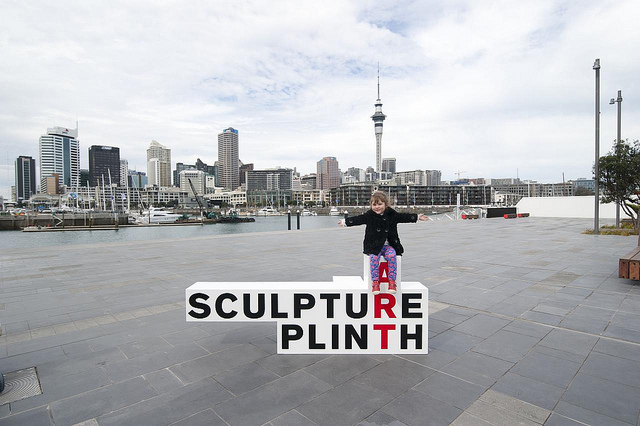
A Sculpture Plinth
In the week before our opening we wanted to get people excited about the Gallery and the concept of seeing art in everything. So we placed an intriguing piece of furniture near the Viaduct Events Centre in the new Wynyard Quarter development by the waterfront - A SCULPTURE PLINTH.
With a photographer on hand and some guides to get the plinth party started, we turned passers-by into living works of art.
Here's just a small selection from the hundreds of shots we took - we had little people...
...bikes...
...safety-conscious people...
...(of all sizes)...
...crowds...
...dogs...
...superheroes...
...fashionistas...
...sporty types...
... and our photographer even crept out from behind the camera to strike a pose.
The plinth was the perfect place for leaping...
...balancing...
...even fancier balancing...
...an inevitable bout of planking...
...snoozing...
or just a cosy kiss.
And you know what? All of this was ART. (Do you see it?)
Makes you ponder, doesn't it?
You can see all the images on the Gallery's Flickr page. The plinth is currently stationed on the Gallery forecourt where you're welcome to take your own photos - if you'd like to share them with us, you can email them to media@aucklandartgallery.govt.nz and we'll upload them.
With a photographer on hand and some guides to get the plinth party started, we turned passers-by into living works of art.
Here's just a small selection from the hundreds of shots we took - we had little people...
...bikes...
...safety-conscious people...
...(of all sizes)...
...crowds...
...dogs...
...superheroes...
...fashionistas...
...sporty types...
... and our photographer even crept out from behind the camera to strike a pose.
The plinth was the perfect place for leaping...
...balancing...
...even fancier balancing...
...an inevitable bout of planking...
...snoozing...
or just a cosy kiss.
And you know what? All of this was ART. (Do you see it?)
Makes you ponder, doesn't it?
You can see all the images on the Gallery's Flickr page. The plinth is currently stationed on the Gallery forecourt where you're welcome to take your own photos - if you'd like to share them with us, you can email them to media@aucklandartgallery.govt.nz and we'll upload them.
Labels:
Amy Cooper,
visitors
Thursday, 1 September 2011
A Gallery blessing
This morning I was privileged to attend the dawn blessing ceremony of the Gallery and the unveiling of three commissioned artworks by Māori artists which form a permanent part of the building.
We assembled across the road from the Gallery and moved onto the forecourt, where three intricately carved works by Arnold Manaaki Wilson were revealed after months spent hidden from the public eye.
Following the elders from Ngati Whatua who were leading the event, we walked through the doors and upstairs into some of the Gallery spaces, passing through some of the beautiful threshhold installations by Lonnie Hutchinson which divide the galleries from the public spaces in the building on every floor.
The procession continued outside to the ceremonial entrance of the Gallery where a karakia was performed over Fred Graham's sculpture Te Waka Toi o Tāmaki:
Next we filed back inside to the atrium where a powhiri took place. Many beautiful and inspiring words were spoken in recognition of the artists' hard work and vision and the duty of the Gallery as a place to store tāonga - and some laughs shared too.
The event was captured on film as well - here's a short video of the experience:
Keep an eye on the website for more information about these commissioned works and make sure you look out for them when you visit the Gallery! Only two days to go now...
Thanks to Bevan Chuang for supplying this image
The procession continued outside to the ceremonial entrance of the Gallery where a karakia was performed over Fred Graham's sculpture Te Waka Toi o Tāmaki:
Next we filed back inside to the atrium where a powhiri took place. Many beautiful and inspiring words were spoken in recognition of the artists' hard work and vision and the duty of the Gallery as a place to store tāonga - and some laughs shared too.
The event was captured on film as well - here's a short video of the experience:
Keep an eye on the website for more information about these commissioned works and make sure you look out for them when you visit the Gallery! Only two days to go now...
Labels:
Amy Cooper,
Gallery development,
special occasions
Tuesday, 30 August 2011
Eye-opening experiences
Friend of the Gallery Warwick Brown shares his memories of the Gallery building in today's instalment of 'If these walls could talk...'
Having been born in 1940 I remember the Auckland City Art Gallery building when the southern end still housed the Old Colonists’ Museum and the library. The former was infrequently visited and the displays never changed. I often wonder what happened to the exhibits when this museum closed.
I visited the Art Gallery as a schoolboy, and it seemed very old-fashioned and atrophied to me. My earliest vivid memory is of the Henry Moore sculpture show in 1957. Moore was already my hero, and, as I had never seen a full-size piece, the maquettes on show seemed monumental to me. I spent hours at the exhibition and returned at least three times, jostling with the big crowds.
This experience was followed in 1958 by the excellent show of British art toured by the Arts Council of Great Britain. It was my first opportunity to view a body of modern work from outside New Zealand, and it further opened my eyes, as it did for many others.
I remember the alterations done to create a mezzanine floor, the new curving staircase guarded at the bottom by a sculpture of a nude seated man, hands on knees. On that mezzanine I will never forget the wonderful show of big, fluted, painted canvas works by Don Peebles. They seemed to me then, and do still, to be works of international importance.
Of the many great experiences I have had in the gallery since, the two big McCahon retrospectives first come to mind. After studying the one in 1972 (Colin McCahon: A Survey Exhibition) on two occasions, I decided McCahon was an invention of the art critics, who were putting one across the public. Thankfully, by the time of the second one the scales had fallen from my eyes.
What else? Frank Womble’s fantastic Zpace Zhow of assemblages, paintings and collage in 1978. Gavin Chilcott’s wonderful painted dining room in the 1980s. The Boyle family’s reconstructions of reality in the 1990s. So much more.
One thing I really miss is the annual show of emerging artists, drawn from around the country. To a young collector they were a great help. Why were they discontinued?
Warwick Brown
Having been born in 1940 I remember the Auckland City Art Gallery building when the southern end still housed the Old Colonists’ Museum and the library. The former was infrequently visited and the displays never changed. I often wonder what happened to the exhibits when this museum closed.
I visited the Art Gallery as a schoolboy, and it seemed very old-fashioned and atrophied to me. My earliest vivid memory is of the Henry Moore sculpture show in 1957. Moore was already my hero, and, as I had never seen a full-size piece, the maquettes on show seemed monumental to me. I spent hours at the exhibition and returned at least three times, jostling with the big crowds.
This experience was followed in 1958 by the excellent show of British art toured by the Arts Council of Great Britain. It was my first opportunity to view a body of modern work from outside New Zealand, and it further opened my eyes, as it did for many others.
Unknown photographer, Mackelvie Gallery Sculpture Court, 1953
silver gelatin print, E H McCormick Research Library, Auckland Art Gallery Toi o Tāmaki Archive Folder PH 01/15
I remember the alterations done to create a mezzanine floor, the new curving staircase guarded at the bottom by a sculpture of a nude seated man, hands on knees. On that mezzanine I will never forget the wonderful show of big, fluted, painted canvas works by Don Peebles. They seemed to me then, and do still, to be works of international importance.
Of the many great experiences I have had in the gallery since, the two big McCahon retrospectives first come to mind. After studying the one in 1972 (Colin McCahon: A Survey Exhibition) on two occasions, I decided McCahon was an invention of the art critics, who were putting one across the public. Thankfully, by the time of the second one the scales had fallen from my eyes.
What else? Frank Womble’s fantastic Zpace Zhow of assemblages, paintings and collage in 1978. Gavin Chilcott’s wonderful painted dining room in the 1980s. The Boyle family’s reconstructions of reality in the 1990s. So much more.
Boyle Family, The Gisborne triptych, 1990
painted fibreglass, Auckland Art Gallery Toi o Tāmaki, purchased 1990
One thing I really miss is the annual show of emerging artists, drawn from around the country. To a young collector they were a great help. Why were they discontinued?
Warwick Brown
Tuesday, 23 August 2011
'Marvellous, moving, magnificent...'
Some members of the Friends of the Gallery have written to us to share their own memories of the Gallery – below is a selection, with recollections ranging from spine-tingling emotion to gluttonous buffet-hogs!
"Far and away my most memorable time was at Te Māori - Te Hokinga Mai. My friend and colleague at the Auckland Teachers College Wally Penetito arranged for a contingent of us to be involved – it was marvellous, moving, magnificent. Those truly remarkable taonga - it made the hair stand up on the back of your neck.
"It was a landmark for Māori and Pakeha - we were all so proud. It changed people’s thinking. We all took our students (the trainee teachers) through and many went more than once. I know I did.
"Often you would see Māori speaking to their tupuna/ancestors. A window was opened to another world that was right here in our own country – it was like glimpsing a parallel universe."
"Far and away my most memorable time was at Te Māori - Te Hokinga Mai. My friend and colleague at the Auckland Teachers College Wally Penetito arranged for a contingent of us to be involved – it was marvellous, moving, magnificent. Those truly remarkable taonga - it made the hair stand up on the back of your neck.
"It was a landmark for Māori and Pakeha - we were all so proud. It changed people’s thinking. We all took our students (the trainee teachers) through and many went more than once. I know I did.
"Often you would see Māori speaking to their tupuna/ancestors. A window was opened to another world that was right here in our own country – it was like glimpsing a parallel universe."
Maris O’Rourke
Visitors explore the Te Māori exhibition
"There is no greater pleasure than a walk around the Auckland Art Gallery and then a discussion of what you've viewed over coffee in the cafe. My memories of Grahame Sydney's exhibition (On the Road: Paintings by Grahame Sydney, 2001) and the memories this raised from my South Island soul will live forever in my memory."
Susan F. Stevenson (nee Graham)
Installation view of On the Road: Paintings by Grahame Sydney
"I will always remember Friends functions where lovely food was served. We always had to dodge a certain gentleman who would always be there and eat himself silly. This was supposed to be a 'finger buffet' but he ate the equivalent of a three course meal!"
Gill Knight
Buffet table at a Friends event, 2005 - please the gentleman depicted is NOT the one mentioned in the above anecdote!
Thank you to the Friends who contributed these stories - feel free to share your own in the comments!
Friday, 19 August 2011
My Gallery
As a born and raised Aucklander, the Gallery was a recurring presence in my childhood. My earliest memory of it is only half-formed: flickering images of intimidating carved wooden figures. A quick talk to my mum confirmed we did indeed go to see the exhibition Te Maori Te Hokinga Mai: The Return Home – I was only four years old at the time but it clearly made an impression.
The first exhibition I really interacted with, though, was Rembrandt to Renoir: 300 Years of European Masterpieces from the Fine Arts Museum of San Francisco, as a 10-year-old. It was a Sunday family outing and we dressed smartly for the occasion. I remember the paintings displayed against black walls and being taught by my parents how to view the impressionist paintings from a distance so they ‘made sense’.
A visit to the Gallery was a common school trip (see also: MOTAT, the Museum, Kelly Tarlton’s). Most of my recollections, however, centre around the journey rather than the exhibitions: riding on a bus, lining up outside in the courtyard for what seemed to be an interminably long time and on at least one occasion spotting a dead pigeon in the fountain. Inside? I haven’t the foggiest idea what we saw but I know we had to be very quiet, and we were not allowed to run around or touch anything. This was a huge challenge for my hyperactive self.
A quick flick through my parents’ bookshelf reveals the catalogue for Love and Death: Pictures from the Collection (1993-1994) so it’s highly likely I was carted along to that too, and I know I saw at least one of the McCahon retrospectives that were held in the 1990s.
In sixth form I started studying art history and a visit to the Gallery was no longer something that was organised for me, but something I instigated. After a term studying pop art, I bowled on up to the Andy and Friends exhibition with my mother and a friend feeling extremely smug for already knowing so much about many of the artworks. How clever I thought I was to be able to appreciate pop art, while my poor bourgeois mum preferred ‘old-fashioned’ landscapes and portraits. We also popped over the road to the NEW Gallery to see Stories We Tell Ourselves: The Paintings of Richard Killeen, where we found more of a middle ground.
Everything changed again when I turned up to university in my scruffy jeans and realised how much I really had to learn about art. Of course, I knew what I liked, but often my reasons for enjoying a painting were nothing to do with execution, technical excellence or profound subject matter. While other students gazed intently upon a Very Serious History Painting and scribbled down notes, I would be sniggering at artworks like Cornelius Johnson’s Portrait of a Lady.
Cornelius Johnson, Portrait of a Lady, 1633
Auckland Art Gallery Toi o Tāmaki, purchased with funds from the M A Serra Trust, 1977
I challenge you to look at this woman without a titter. I love her gormless expression, the absurdity of her broad-shouldered attire and the odd composition that sees her sitting beneath a vast amount of empty space. Maybe I wasn’t the most academic of scholars, but I did learn the importance of having an emotional reaction to an artwork.
After graduating I have to admit I forgot about my gallery. I did make it in to see Rita Angus: Life and Vision and the preview of Julian and Josie Robertson’s Promised Gift (which you can see in its entirety when we open on 3 September) but most of the time it fell into the ‘one of these days’ basket when planning my weekends.
So there you have it – a potted history of my interactions with the Gallery. The thing that stands out when I look through the exhibitions history is how much I have missed. Like many Aucklanders, I’ve spent years professing my earnest intentions of visiting the Gallery more often and never quite got around to it. Countless exhibitions full of artists I now count amongst my favourites have passed me by and I regret this.
So how about you? Were you an avid gallery-goer, or were you only ever dragged in kicking and screaming? In 15 days’ time, we’ll be giving Aucklanders a whole new set of memories, but right now I’d love to hear how the Gallery has looked through your eyes over the years...
Subscribe to:
Posts (Atom)