Thursday, 25 July 2013

The Interns begin editing

Post-production is a major part of any film. Editing takes up a lot of time, which is why we allocated one day for filming and a day and a half for editing. The interns are in at AUT today, using the resources available there.

Today I thought I would introduce the interns, and get their perspective on how this week has gone…

Group One: The Groovesters
Question: 'What is the Value of perceiving art?'
Photo: Waimarie Dashper, AUT Media Mentor

Group 2: Hinoliee
Question: 'What do children think and feel about art?'
Photo: Rachael Short, AUT Media Mentor

Group Three: The Pickles
Question: 'What is the importance of viewing original art work in the flesh?'
Photo: Waimarie Dashper, AUT Media Mentor
 
Group Four: Gender Group
Question: 'How does the gender of an artist effect how view an artwork?'
Photo: Waimarie Dashper, AUT Media Mentor

The overwhelming message from all the groups was how much fun they were having. Being pushed out of one’s comfort zone is never easy but they have all shown maturity these past few days. Yesterday was intense and fast paced and today was no different. I think that the interns where feeling some pressure as even though there isn’t that much time to make everything perfect, there is always a lot involved.

Editing is new to most of the teens, although some have been involved with it before. One girl had experience from being involved in the 48-hour film challenge with her school, even coming third in her category, not bad for a group of high school students!

What myself and the other mentors, both staff and AUT, have been happily surprised with this week is the level of intelligence and thoughtfulness of the teens. The ways that they’re all approaching their films, taking on everything they have been taught, and utilising their skills has been awesome. Even the topics that they have chosen to explore is interesting, their take on situations within the gallery is different from say a staff member’s perspective and we are all excited to see the finished films!

They all agree that this is such a great opportunity and I think it shows. When you actually want to be somewhere, when you are engaged enough in what you are doing, when you are given free reign to create what you like, you approach projects in positive ways. It is different from school, which with its structured lessons and planned timetables – there aren’t many subjects that allow space for self-directed learning.

This internship has given the Interns a taste for what university life can be like, and how technology and creativity can go hand in hand. One girl commented that the internship was exceeding her expectations, and that she hadn’t expected to be given as much freedom as she was. Many of the Interns understood that this internship is more about the process that the product; that their personal growth and experience is equally if not more important than how their films will look.

- Rachael Short, AUT Media Mentor

Wednesday, 24 July 2013

Lets get filming!

Youth Media Interns interviewing Assistant Curator, Mathew Norman.  Photo: Vivien Masters, Gallery Educator
Today the Interns began to film, finally putting their ideas and concepts to the test, and to the big screen! However, today was a little different, as the teens were in total control. It was purely their responsibility to step up, manage themselves, have a good grasp of time management, make sure their filming is relevant to their proposed question – also keeping in mind their own individual roles and requirements. Along side of this, they were given guidelines on what and what not to film:

Here’s a list of what they couldn’t do in the gallery:
  • Use hairspray (As this can damage the work) 
  • Use strong lighting (This can also damage the work) 
  • Use a tripod (This can be dangerous) 
  • Film an artwork without permission (Copyright issues) 

Youth Media Interns practising using their new tools.  Photo: Vivien Masters, Gallery Educator
Jade Lucas, the Gallery's Communications Coordinator was kind enough to get down to the nitty gritty of copyright issues, ensuring the interns had permission forms ready for anyone who they filmed to sign. Then with a brief overview of filming protocols by Sarah and Jacques, the teens were ready to create their shoot lists, and to be issued their equipment for shooting.

The interns learnt today how important the past three days have been. The many hours that were put into goals, values, storyboarding, and tutorials, all lead up to and help make this entire filming process that much easier. Keeping in mind that there is quite a lot of pressure to ensure they got all their desired shots, and that its better to have more footage than you need, opposed to not having enough.

Interns filming Principal Conservator Sarah Hillary in her  lab. Photo: Vivien Masters, Gallery Educator
Each group filmed in the public gallery spaces, and back of house for the interviews with staff. Each of the groups had to organize interviews prior to today, ranging from many different specialties within the gallery:
  • Zara Stanhope – Principal curator 
  • Mathew Norman – Assistant Curator 
  • Robbie Butterworth and Selina Anderson – Senior Gallery Educators 
  • Jack Hadley and Helen Finlayson – Gallery Guides 
  • Sarah Hillary – Principal Conservator 

The teens were lucky enough to have twenty minutes to interview different staff members, and to gain further insight, knowledge, opinions and suggestions towards their proposed questions. Four hours of straight filming made it the most intense, full on and busiest day yet for the interns.

Tomorrow the interns begin editing!

- Waimarie Dashper, AUT Media Mentor

Tuesday, 23 July 2013

Youth Media Interns learn some new skills

Storyboarding at the Gallery. Photo: Waimarie Dashper
Sarah Loggie and Jacques Foottit, the two AUT Technical Mentors led a talk today about different types of films, sound, and cinematography. They showed different examples of professional works as well as their own university work.

Being shown references of short films that some of the interns may not have been exposed to before is valuable because it sparks ideas about the different techniques available to actually make a film come to life. The Interns were then shown examples of how to use film techniques in a way that gets your point across to the audience without being boring or using clichés. We also got to see the films that last year’s teens made. It was beneficial for the teens to watch these as they where able to see what worked and what didn’t work in relation to techniques, as well as what can be produced in such a short amount of time.

They also emphasised the importance of having fun and not being too serious, and being playful and professional at the same time. Because the filming time allocated is only one day there are limitations to what can actually be achieved. However, working with these limitations does have a silver lining as it will teach the Interns the value of time management, and they will be able to be very ‘cut throat’ in what they film.

Developing objectives and storyboarding is an important part of any project, especially when creating films. Having come from school where there is normally never such a short amount of time allocated to a project, it has been an interesting initiation for the Interns. They have been asked to come up with interesting questions, strong objectives, plus they’ve been thrown into the mix with strangers. By now we are all very familiar with each other and it is awesome to see the ideas flowing.

AUT Technical Mentor Jacques demonstrating how to use a video camera. Photo: Waimarie Dashper
The teens were asked to come up with an objective in their groups for their films. The purpose of the objective is to create a clear understanding of what each group want to achieve with their films. I spoke to some of the groups about this and asked if they had ever done anything like this before. A few of them had because they take a Media class at school, but most had not.

We then headed over to AUT where Jacques led a technical demonstration on how to use the equipment properly. I think it is fair to say that everyone learnt a lot from this, he is an excellent teacher and the teens all responded well. Having the Media Mentors involved in the project highlights the beauty of the partnership with AUT Co-lab, as they are able to demonstrate skills learnt through their time at AUT. It gives the teens an idea of what areas they could possibly pursue.

We are only into Day Three but the Interns are oozing energy and enthusiasm. Tomorrow filming begins!

- Rachael Short, AUT Media Mentor

Monday, 22 July 2013

Question time for the Youth Media Interns

Youth Media Interns in their new group. Photo: Waimarie Dashper
On the second day of the Youth Media Internship the teens were split into four groups of three, depending on what their goals where from the previous day. Strategically, Selina and Vivien wanted to pair together people whose strengths and weakness would complement each other. As the Interns will all be given a role within their groups, this way, skills will hopefully be evenly distributed and everyone can achieve the personal goals that they have set.

Interns choosing their Values. Photo: Waimarie Dashper
Before we decided on questions, the teams were asked to develop some values to stick to. Honesty, staying open-minded and humour where really popular. We really want to make this week as fun as possible even though it will also be very full-on.

We had the Gallery Education team come in and introduce themselves. Leading on from the messages the staff we met yesterday said, they really emphasised taking a path that you love, staying motivated, and pursuing all the opportunities that come your way. Hearing this again had a positive effect on both the teens and the mentors, as when you are at that deciding stage of what to actually do with your life, being able to see where your interests can lead you is a major help.

Interns devising their question, which they will base their film on. Photo: Waimarie Dashper 
 Question forming took up the majority of the day. I think that the teens have surprised all of the Mentors and Gallery staff involved by the questions they have chosen to answer. After a lot of head scratching and brain straining, all four groups came up with exciting questions.

The four questions are:
  • What is the value of preserving art? 
  • What do children think and feel about art? 
  • What is the importance of viewing original artwork in the flesh? 
  • How does the gender of an artist affect how you see the art? 
Exciting times ahead…

- Rachael Short, AUT Media Mentor

Friday, 19 July 2013

Youth Media Internship

Day one for the Youth Media Interns. Photo: Waimarie Dashper, AUT Media Mentor
For the next week and a half, the Auckland Art Gallery and partner AUT has invited 12 young adults, ages 16-18, into the Gallery for an intensive internship centered on all aspects of gallery life. They will be asked to pose a question about an area they find interesting, which will then be answered through the medium of a short 3-minute film. The internship is a chance for the high school students to gain professional knowledge of where an interest in the arts can lead and also practical aspects of university life: teamwork, tight time frames, and the development of new skills.

Gallery Educators Selina Anderson and Vivien Masters will be in charge of the interns and the program, while four AUT students will take on the role of media mentor to the interns, including myself. I am here to document the process. All currently studying towards a Bachelor of Creative Technologies, we are here to help manage the interns, encourage goal development and knowledge of technical skills, as well as documenting the entire process.

The internship kicked-off with a quick introduction, read through of the program and a tour of the behind-the-scenes Gallery spaces. The interns had the opportunity to meet some of the staff members who have kindly agreed to be interviewed in the films, get a feel of the Gallery spaces and an idea of how much work goes into bringing an exhibition to life. A highlight of the tour was the Gallery’s print archive room where we were shown two old prints, and told about the process of conservation.

Enjoying a tour of the Gallery. Photo: Waimarie Dashper, AUT Media Mentor
From meeting various members of the Gallery staff, there seemed to be clear messages of do what you love, stay persistent and don’t let other people stop you from perusing your interests. All of the interns come from different backgrounds but are in similar situations; what to do after the safety of school is over? Where can my interests in art lead me? These messages were positive as they came from people who had already faces prejudice towards the art fields and who have over come them.

After a yummy lunch, goal setting and team building took up the majority of the afternoon. Everyone chose at least three goals, highlighting areas to improve on and ways to develop new skills. Most of the teens haven’t worked with any aspects of film before so a lot of the goals centered on this, and all of the teens seemed to be extremely motivated and excited about this project. We chose the groups from the goal sheets, placing together people who had different goals from what they wanted to gain from this experience that can lead into different roles within the group being filled (e.g. development of technical film making skills, leadership, or research and idea developments).

Goal setting and team building. Photo: Waimarie Dashper, AUT Media Mentor
‘This internship is a way for the Gallery to interact with the ‘youth’ audience in Auckland, an area that has always been hard to engage’, Meg Nicoll, the Community Learning Coordinator, says. It is an exciting response to this problem, not only because it allows teens access into Gallery spaces normally hidden from the public view but also due to the involvement of AUT. The teens are at that point in life where they’re starting to think about what they want to study or do at university. By inviting mentors from AUT the interns have access to first hand information on university life. They will be working closely with these mentors, who will help them to develop and produce their films, from the ideas stage to the editing.

The internship will run from the 15–22 July, concluding with a screening of the raw films for Gallery staff next Tuesday. Post-internship, there will be a screening which family and friends are invited to come and view the polished films.

- Rachael Short, AUT Media Mentor

Wednesday, 17 July 2013

The Mocking of Christ, a conservation project

Before treatment picture of the print in its frame
A tiny thumbnail image in one of Webb’s catalogues alerted Curator Mary Kisler and Conservator Ute Larsen to what became a momentous acquisition by Auckland Art Gallery in 2010. The examination work and the assessment of the condition of this outstanding print was undertaken by paper conservators Ute Larsen and Camilla Baskcomb in 2012. It is thanks to the generous support of the Auckland Decorative and Fine Arts Society (www.dfasnz.org.nz), that a grant was allocated for the conservation project of this work.

The Mocking of Christ is an impressive printed work on paper measuring over 2 metres tall and 1.5 metres wide. It was copied by François Langot, a 17th century French engraver from a now lost painting by Sir Anthony van Dyck. Langot specialized in making large scale prints that were used as altarpieces by churches too poor to acquire important paintings of their own. The engraving is made up of nine separate plates printed on individual sheets of paper joined together to make up one image.

The original oil painting by van Dyck of the Mocking of Christ which Langot copied belonged to Sanssouci, Potsdam (Germany). A record published in 1833 states that the painting had originally belonged to the King of Prussia and measured more or less the same size as our print. A drawing after another version by van Dyck is held in The Louvre (France). It is very similar to our print, but Christ’s hair is being pulled to the right of the image by one of the torturers whereas in our print Christ looks serenely away from the mocking figure offering him a bulrush as a sceptre.

This engraving is special for several reasons: its rarity, its size, the fact that van Dyck’s oil painting is believed to have been destroyed in World War II and that there are very few prints made by Langot as he died relatively young.

The only other known examples of this engraving are held in the collections of the Bibliothequè Royale in Brussels (Belgium), the Museums of the Vatican, and in the Irbit State Fine Arts Museum (Russia). Research has revealed that the impression at the Bibliothequè Royale is in perfect condition because the nine sheets are loose and have never been joined. Our print however, was assembled and pasted down onto a canvas backing, probably in the 18th century.


The folio of unassembled engravings held at the Bibliothequè Royale, Brussels
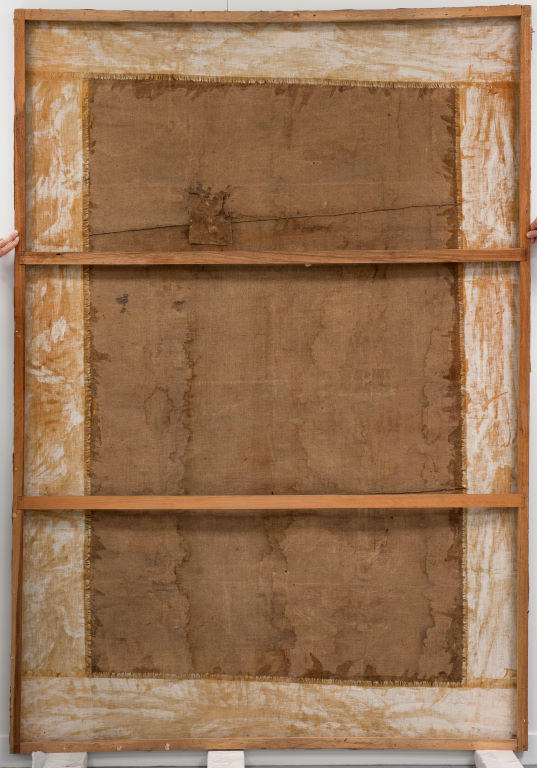
The old canvas is composed of three pieces sewn together horizontally. Canvas strips have been added at a later date along the edges to help consolidate the old canvas and attach it to a wooden strainer. Although the frame is not contemporary with the work, it is part of its history and we intend to reuse it to display the print, once the treatment of the work is completed.


The back of the print, on its strainer. You can see the stitching lines and the consolidation patch that hold the three pieces of canvas together, along with the more recent paler strips around the edges.

CONDITION OF THE PRINT

The print has suffered significant damages through the centuries, notably an earthquake and associated flood, and so came to us in a particularly poor condition. Several areas were cause for concern on close examination:
  • Disfiguring dark brown water stains resulting from the flooding
  • Black and pink mould stains due to dampness
  • Numerous areas of paper loss and cracks
  • A very thick layer of embedded dust, accretions (wax, insect droppings, paint splashes etc) and insect damages, such as borer holes 
  • An area of black over-paint on the knees of Christ
  • Extensive fold lines and creases.
These details of the print show water stains, cracks, losses and black over-paint on Christ’s knees in the left image. The right image shows the original misalignment of the joined sheets.

This raking light picture allows us to see the extent of the creases and fold lines.

TREATMENT PROPOSAL

First, the print needed to be removed from the stretcher and then from the canvas lining, so that we were able to treat the paper. Vacuuming and dry-cleaning was necessary to remove dust and accretions from both the back and front. As it was extremely difficult to work on the print in its large format, we decided to separate it into the nine printed sheets and treat them individually: they all need aqueous treatment, consolidation of weak areas and repair with antique papers where the original paper and image is lost. We intend to rejoin the nine sheets, after lining them with a new conservation support and retouch the repaired areas. However, our initial treatment proposal was not followed completely as we first thought, as some aspects of the treatment were not entirely predictable, and we discovered new problems that pushed us to find an alternative solution.

In the next episode, you will find out about the tests that have been undertaken on the print and the beginning of the treatment. Stay tuned!

- Ute Larsen and Camilla Baskcomb, Works on Paper Conservators 

Thursday, 11 July 2013

Ian Scott (1945–2013)


The news of Ian Scott’s passing came as a shock as I was unaware that he had been unwell for some years. I am grateful to have spoken with Ian about an acquisition that I made last year. I had long known that the Australasian impresario Harry M Miller had acquired Ian’s most ambitious portrait when it was first exhibited in 1969. The painting has not been seen publicly since then. Don Binney at Te Henga, 1969 is the sort of portrait that once seen is not forgotten.

In 2012, because of his book on New Zealand portraits, I asked Richard Wolfe for notes on his response to Ian Scott’s painting:

‘In 1968 Gordon H. Brown… observed that the painted portrait had fallen into “general disrepute”. The pursuit of a likeness was no longer considered desirable, and had been superseded by photography. But a local revival of portraiture was already underway, stimulated by the previous year’s Face to Face exhibition at Auckland’s New Vision Gallery.

Among the artworks shown was Colin McCahon’s uncompromising Portrait of Gordon H. Brown, which hinted at new possibilities for the genre. Perhaps for the very reason that it was unfashionable, portraiture was now taken up by a new generation of young artists, some of whom were taught by McCahon at the Elam School of Fine Arts. 

In the late 1960s Ian Scott began painting a series of portraits of fellow artists, including Colin McCahon, Wellington art dealer Peter McLeavey and, in 1969, Don Binney. As well as being graduates of Elam, Scott and Binney were both represented in Auckland by the Barry Lett Gallery, and shared an interest in the west coast. Scott painted Binney at Te Henga, against the same rugged coastline seen in the latter’s Sun shall not burn Thee by day nor moon by night (1966) in the collection of the Auckland Art Gallery. Binney is placed to one side of the vista, inviting the viewer into a landscape he made his own, and which includes his studio in the middle distance. 

Don Binney at Te Henga is an affectionate homage to a fellow practitioner. Scott has deferred to elements of his subject’s distinctive style, although the swarm of cotton-wool clouds is decidedly unBinney-like. This portrait is a unique record, providing both an introduction and context for the work of one of New Zealand’s best-known and most recognisable artists. It is also the work of another major artist who, along with such contemporaries as Robin White and Michael Smither, was responsible for the revival of interest in the painted portrait in New Zealand.’ 


Ian Scott grew up in Henderson and spent many weekends during his youth biking to Te Henga/Bethells Beach. He explored the beach, islands and hinterland. Scott was impressed that Don Binney, who was five years older, also spent time at Te Henga while attending art school. Interestingly, Ian had been painting Te Henga since 1960, some years before Don began working there.

Ian was 24 years old when he painted Don at Te Henga. It was his most ambitious portrait to date in its scale and intention. Earlier, he had made portraits of Colin McCahon, Peter McLeavey, Gordon Walters and Milan Mrkusich. These were all based on photographs not taken by the painter.


Don Binney at Te Henga was purposely intended to be New Zealand’s largest portrait; it is twice life-size. Scott was inspired by the scale of the portrait heads in the recent paintings of American Pop artists James Rosenquist, Tom Wesselman, Roy Lichtenstein and Alex Katz.

More than other local artists, Scott was looking to the relevance of American Pop art here while tying it to his response to Rita Angus’s realism. He is attempting to update the approach that Angus took in her Portrait of Betty Curnow of 27 years earlier where the interests of both the subject and the artist are combined into one image. By the time Scott painted this work, Binney had been associated with paintings of Te Henga since 1963.

In 1968, there was a flurry in Auckland when the New Vision Gallery showed Face to Face, the first attempt in New Zealand to focus on contemporary portraiture. For a time it was believed that portraiture could become a revitalised genre with Geoff Thornley, Ross Ritchie, Colin McCahon, Peter Siddell, Richard Killeen and Ian Scott making portraits. Killeen and Scott looked to the much-derided suburbia and the bush covered hills that McCahon was then obsessed with. Instead of a landscape that is without sound, devoid of people and containing no evidence of history – Scott envisaged a coastal place that has a champion, and which is populated and has been lived in for some time.

By appropriating photographs and analyzing the way that Binney himself drew Te Henga, Scott used the current Pop methodology of conjoining image source and artistic styles seen in the work of James Rosenquist. Wilderness and habitation become connected. Portrait and location are contrasted in a disquieting way. At the time when this painting was painted, Scott’s cohorts at Elam – students and teachers – were confused. Were they looking at a portrait in a landscape or a landscape with a portrait?

Gordon H Brown wrote: 'Perhaps the most significant development has been the growing interest in a new kind of realism that owes no allegiance to any recent art movement but if anything is closer to the regionalists of nineteen-thirties without necessarily being so naturalistic or regional in outlook. In this respect Don Binney acts as a link rather than a manifestation of this new approach.' (From Directions in Recent New Zealand Painting: Two Views in Ten Years of New Zealand Painting in New Zealand, Auckland City Art Gallery, 1968)

Hamish Keith concurred with Gordon’s opinion and stated in the same publication: ‘There has recently been a revival of interest in an uncompromisingly realist approach to imagery. Rita Angus could perhaps be seen as a precursor to this, but it has been developed and extended since 1962 by Don Binney initially and later Michael Smither and other painters.’ 

Don Binney’s studio at Te Henga was the red barn at lower right. The colonial villa belonged to the Bethell family. The portrait was first exhibited at the Barry Lett Galleries in mid-1969, at which occasion Don Binney had a portrait of himself taken against it. Harry Miller immediately acquired the painting from the exhibition for $200.00 (the same price that the Auckland Art Gallery paid for Rita Angus’s Fog Hawkes Bay that was on display at Barry Lett Galleries at the same time).

Don Binney at Te Henga is intended to appear as if figure and landscape are both seen under extremely bright light. As if overwhelmed by the light’s intensity. The orbs of white clouds reflect the pulsing sensation that one gets from the backlight frequently encountered on Auckland’s west coast. These dots reinforce the glare expressed by the painting. Don Binney is somewhat brought back from this intensity because he is standing in quarter shadow, as if shaded by a tree. The painting is not meant to be naturalistic; it couples the bright and silvery light frequently experienced on this coastline. The fact that there are almost no shadows in the view reflects the notion that the light is illuminating the entire view at the height of an Auckland summer.


For Ian Scott, the painting shows that ‘New Zealand is a very bright and hard edged place. It affirms that my art and Don’s vision was similar. We are getting at the pearlescent light of New Zealand’. The artist consciously wanted to conflate the influence of Pop art with regional art tradition of New Zealand. Time wise, the portrait comes at the mid-point of his realist phase. Sky Dash, 1969–70 was his next painting (Auckland Art Gallery Toi o Tāmaki). Ian Scott was fascinated with what was happening overseas in the 1960s, and it was this international perspective that he brings to his portrait of an esteemed regionalist artist and friend.

I was encouraged to see Ian’s enthusiasm when I informed him that his portrait Don Binney at Te Henga had been gifted by the Friends of the Gallery to the collection. He had thought that his most ambitious portrait had been lost to New Zealand.

With a vocation arching over more than four decades, Ian Scott showed it was possible to be a full-time painter. Few other local painters have been as prolific as he was, even fewer as determined to explore such diverse and, sometimes, divisive content. His commitment to his studio practice was immense and filled with focus. Series after series of paintings emerged. There is much more to be known about the art of Ian Scott.

To his partner Nan, and son Chris, the staff of the Gallery send our sincere condolences.

CREDITS:
Ian Scott

Don Binney at Te Henga 1969
oil on hardboard
Auckland Art Gallery Toi o Tāmaki
gift of the Friends of the Auckland Art Gallery, 2012

Ian Scott

Sky Dash 1969–70
oil on canvas Auckland Art Gallery Toi o Tāmaki
gift of the Artist, 2004

Wednesday, 26 June 2013

Final Frames and Opening

Bill Culbert Level (2013). Photograph by Jennifer French

Day three and a late start for my photography due to filming taking place in the venue in the morning. A soundtrack needs to be laid down, and they don’t need any interruptions. The weather has improved a little with some sun, but it’s still freezing. In the afternoon I reshoot everything I got wrong the days before. I continue to shoot Level, 2013 the set of glass bottles that line the door next to the canal, in an attempt to catch the inverted images of boats passing below them. Level takes a lot of time, as it is open to the canal, and faces the Carabinieri’s jetty on the other side. There is a lot of coming and going by the policemen over there, and they seem to like to get their boats in shot. Later, in the evening I finally get HUT, Made in Christchurch, 2012, the wardrobes and Where are the other two?, 2013. Finally, I have some finished images to pass by Justin and Bill for approval – but still not everything. The installation is complete and the install team are relaxed for the first time. I can now send some low-res ‘teaser’ images out to the international press.

Bill Culbert, Walk Reflection (2001/2013) and Walk Blue (2001/2013). Photograph by Jennifer French

My day four was an official day off for everyone. There’s a flurry of rendezvous on Fondamenta Nuove at the boat stop at 11.10am for the 11.25am #13 vaporetto. We’re on an expedition to a rustic restaurant on an island half an hour’s boat ride away. There we have lunch in the sunshine in an idyllic calm to celebrate the completion of the installation. It was the first warm day since we’d arrived and a chance to recharge. And, unbelievably, the first time we’ve all sat down together. It provides some calm before the storm of the press previews and the vernissage later in the week.

Monday and Tuesday 27 and 28 May merge into one, yet manage to feel three weeks long to me. There are so many things to do. I re-shoot, output and re-output images, doing prepress as I go, have them approved. Resized. Backed up. Begin uploading to media site. Rework, re-shoot, resize, re-approve. Upload. Half upload. Slowly upload . . . It’s getting tight, my deadline approaches. I sat down at my laptop at 7.30am, and was sent home when the venue was locked at 9pm, as we all had to come back for the blessing of the venue the next day at 6.00am. I walk the half an hour home with the laptop, and continue to upload the images from there. Monday tips over the edge into Tuesday. Then suddenly – it’s done.

Next it’s the vernissage, the opening event, and for me, starting the new photography for the catalogue.

A big thanks to CNZ and all at Auckland Art Gallery who supported my work for the New Zealand project Bill Culbert – Front Door Out Back at the 55th Venice Biennale, especially my manager Catherine Lomas and colleague John McIver.

- Jennifer French, Gallery Photographer

Friday, 21 June 2013

The Perfect Portrait

My second day dawns early, due to the time distortions of a jet-lagged brain, and before 8am I am back at work with the others. It’s slower than I anticipated. I am also chasing the ‘hero’ portrait of Bill, who while being immensely affable and warmly disposed, is turning out to be extraordinarily difficult to photograph. So I leave the laptop to its own work converting raw files to chunkier formats, and attempt to capture the artist. We try a longish shoot in the room with Bebop, but the room proportions make Bill appear ill proportioned, as the artwork is vast. Everything appears out of scale. It’s frustrating, as it is the image everyone including me has pre-visualised as The Great Image. But it isn’t, so after working on it for too long with no good result we break for lunch.

Bill Culbert at the entrance of the New Zealand Pavilion, La Pietà, for the 2013 Venice Biennale. Photograph by Jennifer French
After lunch the rain stops, and the wind has dropped, but it still feels like the middle of winter. I’m outside in the ‘wardrobe’ courtyard checking out the possibility of shooting something there later, after the tarps come off, when Bill pops his head out the door and grins at me before disappearing again. The light looks really beautiful. I go in and convince him to stand in the doorway again. Behind him on the other side of the room there is a delivery being made from a boat in the canal, so Bill says, ‘But won’t they be in the way behind me?’ I tell him it’s just a test shot, and so it doesn’t matter. Then I say, ‘Never trust a photographer!’ He laughs, and I get the picture I was after.

Bill Culbert Strait (2013). Photograph by Jennifer French
The day progresses. HUT, the un-finished work, is still . . . unfinished. Bebop has a new element, a large pane of glass that reflects the open door with sky. Right. It’s important to shoot Bebop and Drop with the door open, with the glass in place. Okay – a reshoot. Also, it turns out that because I’m only five foot four, I have missed the light detail on the lids of the milk bottles in Strait. Another reshoot. Thankfully the weather is improving and we have some sunshine. More people arrive – the commissioner, the deputy commissioner, the ex-commissioner, gallerists (multiple and multilingual), some patrons, the artist Orlan with horns lightly gilded, British artist Mike Nelson (the toast of the 2011 Biennale in the British Pavilion). Bill’s show is very popular. And we are not yet open.

- Jennifer French, Gallery Photographer

Thursday, 20 June 2013

Setting up in Venice

Bill Culbert’s Front Door Out Back is installed through a set of six interconnected spaces that run along the side of the church of La Pietà. The technical team have been working on the installation of the works in Venice since the beginning of May, and by the time I arrive with my 16 kilos of gear ready to photograph the exhibition they have finished most of the install. Out the back of the venue is a temporary ‘situation room’ with Wi-Fi, and a cluster of laptops and phones where the team is located. On the wall there’s an imposingly complex chart with an hourly breakdown of the days 27–31 May. Everyone looks settled in, even when they’ve only been there a few hours longer than me, so I find a spot and plug in my laptop, assorted battery chargers and phone, and hook up to the Wi-Fi.

Bill Culbert, Bebop (2013). Photograph by Jennifer French
After a quick orientation of the show with Bill Culbert and curator Justin Paton, I dive into the photography, starting at the Front Door section – the works called Drop, 2013 and Bebop, 2013. These works are large ceiling suspended clusters of furniture and fluorescent tubes that span the entire length of the room. All the scaffolding used to install is now gone, and there are only a couple of ladders to move so I can begin to photograph it. I’m impressed that the works are so complete by the time I arrive. The predictions from Terry, Sean, John and Rae are that absolute completion will most definitely occur at 6pm Saturday 25 May, give or take an hour.

So on my first day I finish the shoot in the Bebop room, and begin to move through to the work installed in the corridor, called Strait, 2013 – a horizontal set of Anchor milk bottles bisected by a florescent tube. Everything is going well, and my lens choices made in New Zealand are all working out fine, now I’m actually in the spaces. So far so good. It’s raining and windy outside where the two wardrobe works Walk Reflection, 2001/2013 and Walk Blue, 2001/2013 are installed, and they have protective blue tarps tied over them, so I can’t shoot them yet nor the views around them to the connecting spaces.

Bill Culbert, Daylight Flotsam Venice (2013). Photograph by Jennifer French 
The large work Daylight Flotsam Venice, 2013 in the main room out the back is illuminated and looks amazing in the dull weather’s low light. I get some shots done in there, looking out towards the canal and Level, 2013 but can’t do any wider shots or views through to anything else. There’s still rubbish in the view outside to HUT, Made in Christchurch, 2012, and the entire install team is outside in the rain reworking its installation. Bill is rethinking Bebop’s final configuration. I can’t get near the room containing Where are the other two?, 2013, an artwork that I think has one of the best titles I’ve ever heard. There is a pigeon, yet to be evicted from one corner of the room, and tools all over the place. But the work looks good glowing away to itself, with the sound of water taxis and delivery boats side wash against the building as they pass by.

So far I’m feeling confident with four days before my deadline for the initial media images. I’ve shot as much as I can, so I begin the downloading of image files. It’s wonderful shooting 36MP images, but it’s clear that when they unpack to 100MB per image that life is going to slow down little. So I churn through the first day’s image files, bit by bit.

- Jennifer French, Gallery Photographer